
Heretic
July 23, 2026
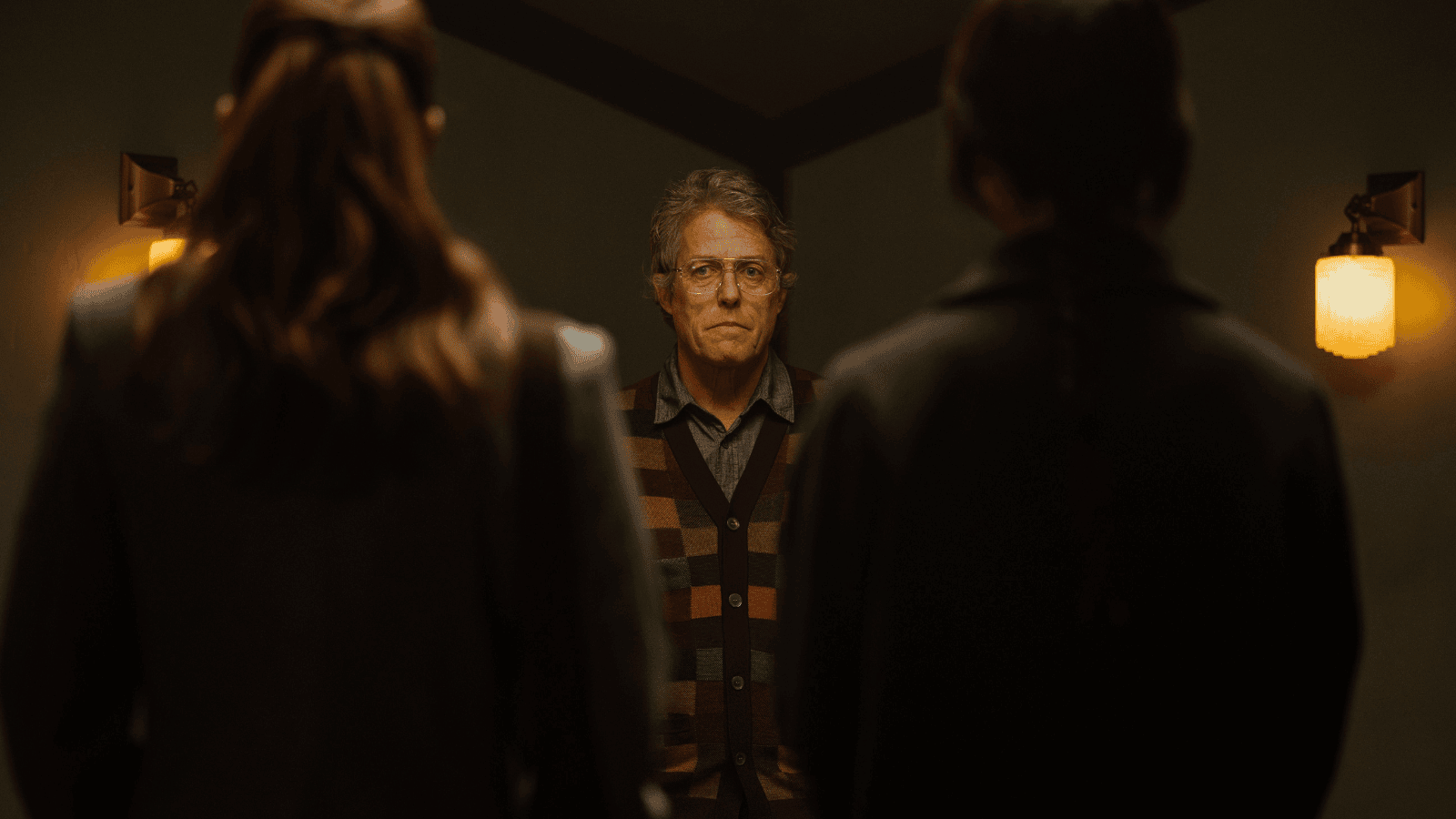
This week, we discuss Craig’s pick, A24’s 2024 horror film Heretic, noting its strong reviews, the writers’ long theology research, and how it rewards rewatching.
We praise the film’s claustrophobic, dimly lit first half as Hugh Grant’s Reed lures Mormon missionaries Sister Barnes (Sophie Thatcher) and Sister Paxton (Chloe East) into a polite but escalating philosophical trap, using arguments against religion while the women prove smart and resourceful.
We debate plot contrivances, Reed’s improvised psychopathy, and the intentionally ambiguous ending that raises existential questions without taking a firm stance.
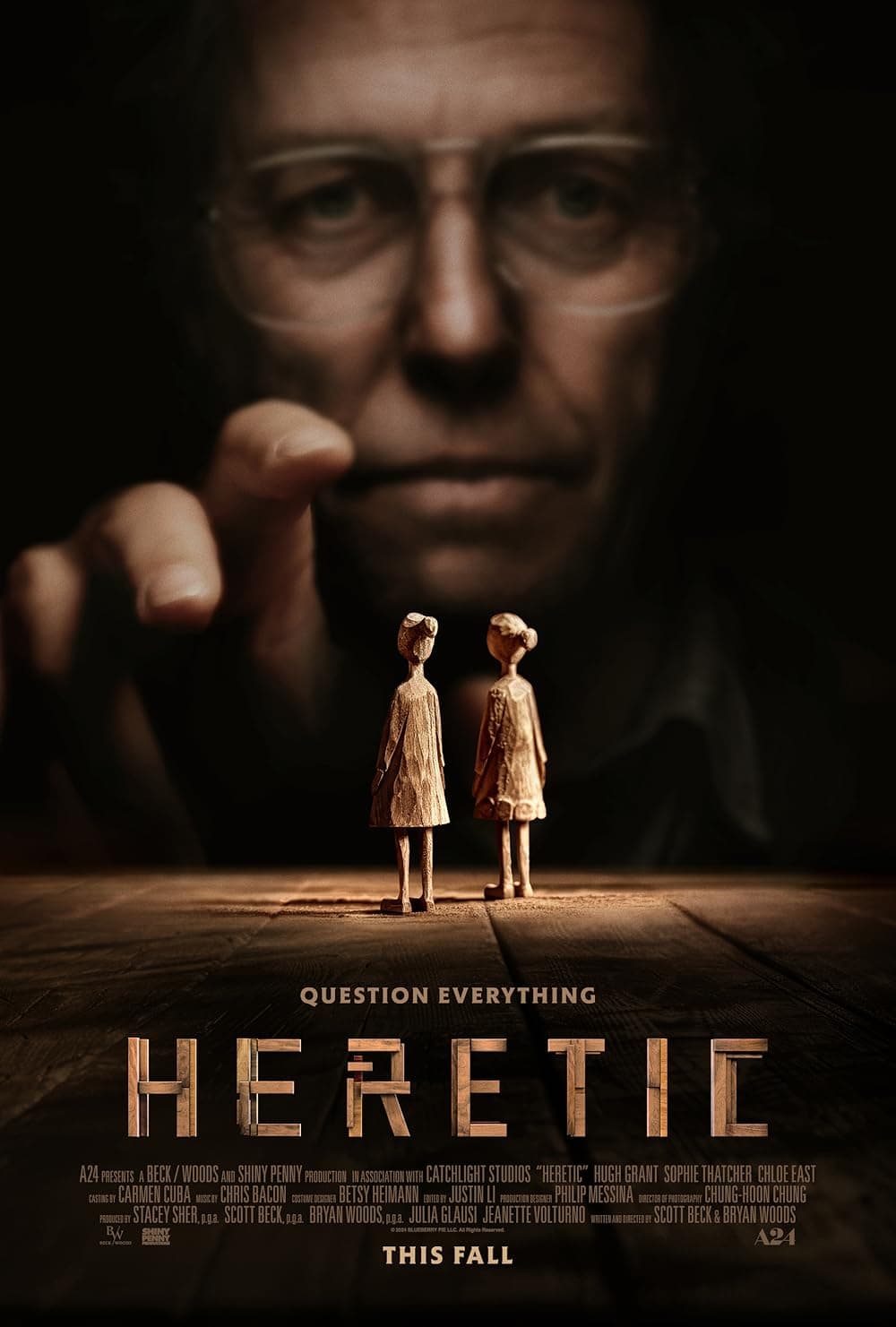
Heretic (2024)
Episode 498, 2 Guys and a Chainsaw Horror Movie Review Podcast
Todd: Hello and welcome to another episode of Two Guys and a Chainsaw. I’m Todd.
Craig: And I’m Craig.
Todd: Well, this week, Craig, was your choice, and you chose a pretty modern film, 2024’s Heretic, which was actually pretty well-reviewed when it came out. I think it’s got a seven on IMDb. It’s got at least 80 or 90% on Rotten Tomatoes. And, uh, it was done by the same guys who did another movie or two that people were pretty impressed with, which was A Quiet Place- Mm-hmm
I believe. And we also did Haunt in 2019, and I think we enjoyed that one quite a bit, if I remember correctly.
Craig: I think so, yeah.
Todd: But he- they’ve done quite a few other things. The Boogeyman. I don’t know. The Quiet Place really took off, right? But I think they only did the screenplay and story for the original.
Craig: Yeah. They were writers on it, I think.
Todd: So, uh, Heretic, I had actually seen this twice before . I don’t remember why. When we org- when you originally brought this up, I thought we had done it on the podcast ’cause normally I just don’t watch horror movies until… unless we’re gonna do them for the podcasts these days.
And, uh, it must have been somebody who really wanted to see this with me. So we, uh, took a look at it, and I saw it and, and, I don’t know, maybe went back to see it again with somebody else. I, I enjoyed the movie, and I was really happy to watch it the second time around. Even though it has twists and turns in it, I think it was the kind of film that w- works even better on a second viewing once you kinda know where it’s going because it gets a little heady at times.
And so it’s good to have the second opportunity to go through it again with a more critical eye and kinda decode the messages that it’s trying to say because the, the writers of this movie really took, took their time with it. I think they said that they worked for about 10 years on the screenplay just because they were doing, uh, research on theology and stuff like that and really wanted to make it deep, so.
Craig: Mm-hmm.
Todd: Here we are, Heretic, starring Hugh Grant as well. How about you? Why did you recommend this? I assume you’d seen it before?
Craig: I had seen it before, and I don’t remember when, but it’s been a while. I would say at least a year, if not more. And I don’t remember when I saw it the first time if I knew anything about it.
I maybe had seen a trailer, but I, I just remember that when I watched it, I thought, “Oh, this would be a really good one to talk about on the podcast.” And I may have mentioned it at some point, but we never got around to it, and I kinda forgot about it, and that happens all the time.
Todd: Mm.
Craig: But, uh, I was looking for something to watch, and I stumbled across it again, and we needed something to watch, and, and I thought it would be interesting to talk about- Yeah
for a variety of reasons. But it’s funny because you… When, when I brought it up, you’re like, “Haven’t we already done that?” And the more I thought about it, I was like maybe we did, but we didn’t, I don’t think.
Todd: It’s not coming up on my search.
Craig: No. I, I th- I think maybe part of the reason that I thought that we had is because after this movie was over, I feel like I thought about it a lot.
Mm. And so maybe that translates into memory of talking about it. But that’s one of the things that I like about this movie, and it’s an A24 movie, right?
Todd: Yeah.
Craig: And, you know, A24 is getting really big, and, and they’re kinda branching out and doing different things, but my experience with them has been really positive.
I tend to really like the stuff that they put out because it’s unique and interesting and often unexpected. The stories themselves or, or twists in the stories often take me by surprise, which is refreshing. They’re entertaining, and they’re well made, which is the most important. You know, those are the most important parts, but they also tend to make me think more than your typical fare.
Todd: Yeah.
Craig: And I don’t need tha- And I don’t need that all the time. I don’t need horror movies or movies in general to really make me think. In fact, sometimes I don’t want that. No, right. Sometimes I’m going, sometimes I’m going to movies specifically so that I don’t have to think, especially about serious things.
But occasionally, and when it’s done well, I like it, and this is one of those cases.
Todd: Yeah. A24 reminds me of what the film industry kinda used to be like. particularly in the ’70s, right, when it was really exploding with a lot of experimental movies and a lot of independent cinema that made it to the big screen.
Like, the, the movie-going audience had a lot to choose from, and this was sort of before the age of the blockbuster, right? So nowadays, the studio model seems to be let’s invest a lot of marketing and money into these huge tentpole films that are almost guaranteed successes- Mm-hmm … so that we can stay afloat and y- and then fund, you know, the smaller movies as well.
But, but they seem to do less and less of funding smaller movies, and they just wanna go from tentpole to tentpole. It’s like the book industry. I read that at one point, and I think it’s still true today, that it’s really the blockbuster authors that float Every major publishing house. But publishers, editors then, you know, take that money and they turn around and, and invest it in taking chances on newer authors.
Sure. That’s what editors pride themselves in doing. Whereas the movie industry s- I- seems to be veering away from that model. Anyway, it’s a lot more expensive nowadays to make movies, and it’s harder to get them distributed if you’re not a big, giant studio, and movie theaters basically just show the big studio films and are not gonna take a chance on some indie production.
The days of sh- you know, shooting your movie with your friends and shopping around to movie theaters and drive-ins and stuff are over. So, you know, that’s kinda changed the kind of films that we get, and so it’s really neat to see a studio like A24 get well-known for doing these kind of movies that are just off the beaten path.
They’re unique, like you said. It seems like they take a lot of chances on really odd, interesting, bizarre, fun material. You kinda know you’re guaranteed to get a film like this. You may not like it, it may not be successful, but God, they’ve had a lot of hits.
Craig: Yeah.
Todd: And this is just exactly the kind of film that they make.
I mean, when you’re open up an A24 movie, this is exactly the kind of movie you’re hoping to get, I think.
Craig: You … Well, I, I think part of the fun of it is that you never really know what you’re gonna get. This movie surprised me in several ways. I, i- in fact, in at least one way, to me, it kind of feels like two different movies.
The first half and the second half feel like very different kinds of movies, and I like them both, and, and the transition is interesting, but I think that’s … Whether or not the balance works, I, I think is a good point for debate. But you mentioned the directors. I don’t remember who. I- it’s a team, a writing and directing team, and I don’t remember which one of them it was, but one of them was inspired to think about this story by the death of his own father.
And when his father passed away, uh, you know, and, and he was an adult, it, of course, made him start having, like, existential thoughts about life and death and, and belief and faith and, and what happens to us after we die and, and all that stuff, and he wanted to take kind of a serious approach. He wanted to approach the idea of religion and faith and death and the afterlife, he wanted to approach it in a serious way, but in a horror movie.
I don’t know. You know, i- in terms of … You, you mentioned before, like, I don’t remember even exactly the context of what you were talking about, but you s- you said something about, like, what the movie has to say or what these types of movies have to say. I don’t know if I walk away from this movie feeling like it really has a strong message one way or the other It almost presents itself like an existential puzzle.
Yeah. It, it’s more … I, it, it … To me, it feels more about presenting questions- Than providing answers … than about positing a lot of answers. Right.
Todd: Yeah. I think it’s deliberately vague in the end, and I feel like that’s just as well. Some people might call it cop-out, I suppose. But I don’t know, these movies about kind of a crazy person or crazy religious person, they don’t tend to do themselves many favors if they try to land one way or the other on some religious debate.
Like, what is the meaning of life? Does God exist? You know, that kind of thing. So much easier to just be like, “Well, this is this one unhinged person’s perspective,” and you can just leave it at that because it’s a horror movie. We’re, we’re, we’re looking at what he does with who he is in- instead of necessarily solve those questions.
It’s not really the forum for that I think.
Craig: Yeah. A- and, and to, you know, talk about crazy people or, or, or zealots or crazy religious people or people who are trying to answer these big questions about God and faith and, and life and death and all of those things, that is kind of a stock-type character, but that’s one of the many ways that this movie subverts things for me.
Because Hugh Grant, they wrote this movie at least in part with Hugh Grant in mind because they had seen, he had said somewhere in an interview that he feared falling into a particular niche or, or category and, and being typecast. And, and there was a period in his career where he was doing very, very well, uh, you know, professionally and financially, but I, I don’t think that he really was thrilled doing all of those rom-coms in the ’90s.
Todd: Mm.
Craig: So they wrote this with him in mind and, and he was a little … I wouldn’t say that he was reluctant to take it based on what I read, but he was … There was a lot of conversation that was had, and he had a lot of input before he finally decided to take it, and he did. But Hugh Grant is really charming and really charismatic and handsome, and his character is also Clearly really smart and well, I don’t know if well-educated is the right word, but well-read.
You know? Like, he kinda knows what he’s talking about. And, and we’re, we’re jumping the gun, but as an antagonist, which he seems to be, you- I found myself not necessarily agreeing with him, but z- like seeing his point of view. He, he, he wasn’t just a bad guy. He is a bad guy n- no question, but, uh, a- an interesting one.
And another way, I don’t know. I don’t think that this subverted any expectations for me, but it would’ve been easy. The, the movie focuses on these two young women. Everybody, the three main characters, none of them are given first names. Hugh Grant’s name is Reed, Mr. Reed, and the girls’ names are Sister Barnes and Sister Paxton, who are Mormon missionaries, and they’re, they’re going door to door to spread the word or whatever.
Sister Barnes is played by Sophie Thatcher, who I’m a huge fan of. I mean, she’s really establishing herself as a scream queen in the genre right now. She’s done a lot of big budget movies. She is in the, the Showtime series Yellowjackets, which is a really good show, and she’s… It’s a great show and a great ensemble cast, but she’s a highlight.
And then Sister Paxton is played by a girl named Chloe East, who I don’t really know a whole lot about But she’s great in this movie too. It focuses primarily on these three core characters, and they’re just all really good. They’re all played really well. It’s shot really well. It’s directed really well.
But it would’ve been easy and stupid for them to make these girls, uh, stereotypical.
Todd: Uh-huh.
Craig: I- either as Mormons. They even talk about… They, they mention the, the South Park guys’ musical Book of Mormon and- Mm-hmm … you know, are kind of concerned that that might be people’s perception of them. I don’t think that the, the filmmakers had any interest in belittling or making fun of Mormons, and I think that that’s kind of l- for whatever reason, maybe it has to do with the South Park guys’ musical, but it seems like that’s kind of low-hanging fruit.
And the approach to these young women, not only do they seem kind and, and respectful and, and courteous and, and all of those things, but they’re smart and, and resourceful. Though Mr. Reed ultimately challenges their faith, it doesn’t seem to be an attack on any particular faith or denomination, and I appreciated that too.
Todd: Yeah. I mean, I don’t think there’s a lot of space in this movie for us to really dive too deep into their characters. A lot of it is dialogue between them and him, and not much of it gets terribly personal. It’s mostly philosophical, and then by the end of the movie, it’s just them trying to survive. I wouldn’t say that I feel like these are two…
Maybe the diversity here comes from the fact you have two different girls. You know, they’re not alike. They’re alike in the fact that they’re Mormon and they’re missionaries and they’re believers, but they seem to have different approaches and different, like, levels of faith. And I feel like Sister Paxton is the person who’s painted as the, what you might call stereotypical Mormon.
She’s just very, very full of faith, very full of positivity. She doesn’t seem to question too much. She seems to be really toeing the line quite nicely. N- not to say that this isn’t genuine, I’m just saying that that’s just who she seems to be. Super polite even when she shouldn’t be and all that gets her into trouble.
I feel like Sister Barnes is the one who seems a little more She’s clearly has her faith. She clearly does believe in God. She’s not as willing, as you would think, to question it so much, but she’s got a little bit more of an edge to her. She seems, in my mind, to be just a little more thoughtful, maybe a little more intelligent than the other girl.
Craig: Uh, I don’t know if I’d say that. I- All right … I would say it’s a, a difference between kind of naivete and being worldly-wise. Like- Maybe
Todd: that’s it … S-
Craig: Sister Paxton has been raised in the church, and it- True … it appears, it appears that her experience is somewhat limited to that experience, whereas Sister Barnes was not raised in the church.
I, I think her mother died, I think. Yeah. Or, or her da- One of her parents died, and I think she and her dad, she said that they auditioned a bunch of different churches- Mm … before they finally landed on Mormonism. So not only is she relatively new to the faith, but she’s been through some difficult things in her life.
And sh- before picking this faith, she kind of educated herself in, in other faiths, too. So it’s set up, it seems like in the beginning, that they are trying to paint Sister Barnes as being the one who’s kind of questioning the faith. Like, Sister Paxton seems like she’s completely resolute in her faith, but it seems like they’re setting Sister Bar- Sister Barnes up to be more of a questioning person.
Yeah. But I think that’s a little bit of a mislead. Yeah. I don’t think that it’s necessary… I don’t think that it’s that she doubts her faith.
Todd: No.
Craig: It’s just that she’s She is somebody who questions, and that’s not a bad thing
Todd: Yeah, and I- my shortcut for that is I think she’s just smarter about it, I think is what I say.
And I mean, look, you know, you’re, we’re all products of our upbringing, and sometimes w- we just have a certain naivete just because we don’t know any better. We’ve never been exposed to anything else. And so a person who’s naturally been a little more worldly or come to the faith of their own volition, like you said, after searching, and has had all these other experiences and has had ways of thinking, you know, outside of God and, and that sort of stuff, is definitely going to have, I think, a much more naturally balanced perspective on everything than a person who was raised in it and hasn’t known any different.
And so I guess, you know, saying she’s more intelligent is just, is maybe not accurate. It… What I mean to say is she’s more worldly, and I think she has more to pull from when it comes to reasoning these things out and her pers- and a perspective.
Craig: It’s interesting, though, because I think that it almost feels like we’re set up to view Sister Paxton that way.
Todd: Mm.
Craig: Sister Barnes is the tough one. She’s the one who’s on her toes. She seems to be a little bit more well-read, more educated, more worldly wise, and Sister Paxton appears to be the kind of doe in the headlights. She’s, she’s usually taking her lead, taking her cue from Sister Barnes. But I think that that’s intentional so that they can-
Todd: Switch it around?
Craig: surprise us later. To, not necessarily switch it, but I mean, without spoiling anything, Sister Paxton is not stupid.
Todd: Right.
Craig: And, you know, she may not be as well-read, but she’s not incapable. She’s not dumb. She’s not incapable of figuring things out, and when necessary, she’s not incapable of taking care of herself.
Correct. And, and that was one of the ways that it kind of subverted my expectations, and it comes at a moment. There was one particular moment in the movie that really took me by surprise. Mm. And it kind of had to do with that revelation. But that’s really getting ahead of ourselves. I guess we should say, you know, we’re introduced to these girls.
They seem very, very nice. Sister Paxton, the only thing that she really kind of seems to be, not questioning about her faith, but struggling with, is that she’s a kind of a girly girl, and she sees other teenage girls, air quotes, normal girls, you know, having fun together on the street, and she tries to engage with them, but they end up just making fun of her-
Todd: Yeah
Craig: because of her Mormonism. They, they, they pants her and, and make fun of her traditional undergarments or whatever.
Todd: Yeah, talk about their magic underwear.
Craig: Right. I mean-
Todd: Easy target.
Craig: It is. I mean, I mean- It’s a thing, but whatever. So whatever. Th- that’s how they’re set up. They go to this guy’s house. He seems very charming and charismatic, but I don’t know.
I mean, I, I, I think it’s projected. Of course, we’re watching a horror movie, so we know that there is potentially something off about him from the very beginning. They wanna come in and, and talk about Joseph Smith or whatever, but they say, “We can only come in if there’s a woman in the home.” I assume that’s a real thing.
It, it, it seems that the filmmakers really went out of their way to make sure that they were portraying things in a fair and accurate way. And if that’s the case, and women Mormon missionaries, or any missionaries for that matter, have that rule, that’s super smart.
Todd: Yeah. W- well, I think they had a Mormon person as an advisor to make sure that they were getting that, those parts accurate.
And I did read that after the movie came out, different religious people had different takes on it, and some representative of the, of the Mormon Church, or maybe just a prominent Mormon pastor or something, did come out and say that they appreciated the fact that this movie in, in some ways served as a cautionary tale for other missionaries to, like, you need to follow the rules and, and you know, and make sure that you’re taking care of yourself or bad things can happen to you as well.
And, uh, that w- I thought that was an interesting take on the messages of the film. I- in w- in some ways, the movie reminded me, this aspect of it anyway, reminded me of like, uh, Oh! Barbarian-
Craig: Yes …
Todd: Funny Games, these films where people are so polite that their politeness can get them into trouble.
Craig: Right.
Todd: And certainly in this case, almost to a comical degree, actually, and I think there’s definitely some moments of comedy where even when things are getting very intense, these w- at least one of these girls cannot help but be so polite, because it’s how she’s programmed, that you’re just like, “Oh girl, come on.
You’re in a situation here.”
Craig: Th- well, there al- but there comes a point where it also seems to be, I don’t know if a defense mechanism is the correct word, but-
Todd: Hmm, a way of keeping things diffused?
Clip: Yeah.
Craig: Yeah. Right, right. But I mean, I don’t know. He manipulates them. He gets them to come in the house. He says he has a wife.
Clip: Prophets- Talking of Noah, it is very, very wet … teach about
God and receive revelation a- and they interpret the Word of God and, and preach the gospel to the world. And because of apostles, people who know the gospel- Would you like to come inside? D- do you have a girl roommate? Yell who? A, a roommate. We can’t come inside unless another woman is present, but, um, we can, uh, stay out here in the doorway if that’s fine with you.
It’s just for safety. Oh. We don’t mind the rain. Well, my wife is home. Does that count? Yeah. Perfect. Okay, good. When you said roommate, I panicked. I, I haven’t had a roommate since, uh… Anyway, I, I have a soulmate, and that is good enough. Yes. That’s great. We’d love to come in and meet your wife. Then come on in.
Great. Do you like pie? Yeah. My wife has pie in the oven.
Craig: And so they’re relieved, uh, but they naively go into the house without meeting the wife. And, and he locks the door behind them, I think, and he immediately says something like, “Oh, by the way, there’s metal in the walls and ceiling.” And they’re like, “Okay.”
Todd: Yeah, that’s fine. Ding, ding, ding, ding.
Craig: Well, I mean, he just says… It, it’s just such an odd thing to say, and he says it in just such a casual and offhand way that I think that they don’t really know how to respond. Like, we, as viewers, are watching the movie. We know something’s going on. I immediately thought, “Oh, well, their cellphones aren’t gonna work in there-”
Todd: Yeah
Craig: which, which is the point. But he tells them his wife is in the kitchen and, and he keeps making excuses for why she isn’t coming out. She’s shy or whatever, but she’s making a pie. She’s making a blueberry pie. He starts to ask weird questions about… Well, not weird necessarily, but a little bit invasive or intrusive so quickly, I guess.
And, and, you know, he asks about her dead dad, and there’s some awkward stuff going on there. But then he asks them their, their feelings on polygamy. Gosh, I don’t know. It, it all gets down into lots of, of stuff about religion and organized religion.
Todd: Yeah.
Craig: But again, this is mostly a ruse. But this whole scene with them sitting in the living room talking casually, it’s shot in such a way, and the whole movie is shot in such a way that it feels, I don’t know, claustrophobic and uncomfortable.
Todd: Mm-hmm.
Craig: There’s a lot of, you know, extreme close-ups on the actors’ faces to kind of show you Their level of comfort and, and I don’t know, I just thought that it was very well done. It’s, it’s tense and suspenseful and you wonder- I wondered, where is this going?
Todd: Right.
Craig: And, and I, I didn’t know. I was, I was scared for these girls.
I knew that they had put themselves in a precarious situation, but I didn’t know where it was going.
Todd: You know, the lighting is very dim in this film. It- almost all throughout, I c- I can’t really think of a scene except for the… Even in the very beginning it’s a bit washed out. You know, when they’re outside doing things, it’s almost like overcast and washed out.
So the whole picture feels pretty, in a murky way, it’s almost like fireside chat impression-
Craig: Yes …
Todd: that you get, right? There’s, it’s, it’s kind of a glowing light that’s in there but it’s not necessarily a, a good one. It, it all, it contributes, I think, to the unsettling nature of it. I mean he has a candle in there as well and it almost seems as though the movie’s intended to be lit by this candle that he has.
At one point the electricity seems to flicker. Some lights do go out and he’s like, “Oh, that happens from time to time.” There is a storm brewing outside so we get that as well. So it’s almost like they’re inside this impression of taking shelter by the sto- from the storm by a campfire. To the visual, these are the kinds of conversations you would have around a campfire where everybody’s staring into the fire and talking about God or, or the meaning of life or what’s important to them or what their goals and dreams are.
But you know he’s really turning this on them as well by questioning them in a very intelligent way. He’s very clearly practiced in this and he clearly knows a lot about the Mormon faith already even though he has asked for the information. I mean it- they’re not going door to door just to random people’s homes.
They’re going to people’s homes who have asked for information so this guy’s actually invited them there in a way. So he’s expecting them and then it turns out that he’s a guy who actually knows quite a bit about the Mormon faith because he’s immediately questioning them about some very specific things, uh, based on their history and stuff.
And so you could see why that would be very uncomfortable for the girls because right away they feel like they’ve fallen into a bit of a mental trap- Mm … this guy has kind of set up for them and they’re not ill-equipped to deal with these questions but you can tell they’re uncomfortable because now they feel like- Yeah
they’ve been there under false pretenses I think.
Craig: Well, yes. The first time I watched this too, I don’t think that I noticed how claustrophobic it was. Like, I, I, I don’t remember seeing any windows. If there are windows, all of the drapes are closed. It does feel… The lighting is very yellow, like firelight, like you said, but it, it feels very enclosed.
And there are no pictures anywhere on any of the walls. It’s all very sterile. There’s only one picture in a frame in the whole room, and it’s of him and a dog, and I think Sister Barnes notices that. She, she seems to be very aware of her surroundings. Mm. But like you said, at this point it could just be that he’s an asshole.
Yeah. Like, somebody… And I, I, I… There are people who do stuff like this, like invite missionaries into their homes or whatever to try to ridicule them or to try to have theological debates with them. Like, that’s a dick move. Like, if you don’t wanna talk to the people who are coming around to talk to you about their faith, just don’t talk to them, but don’t berate or ridicule them.
Just leave them alone. They’re, they’re doing their thing. They’re not hurting anybody. Yeah. But it, it could just be that. It appears like he may have lured them here to challenge them on the aspects of their beliefs and the history of their religion, because he does ask them about polygamy, which again, you know, if you wanna talk about low-hanging fruit, if you’re gonna go after Mormons, I mean, that’s one of the, you know- Easiest ways
I guess if you’re gonna be… The easiest ways, I suppose. But she, Sister Barnes, responds to it in a very articulate and logical fashion. I- in fact, it was probably the most articulate defense, and not defense, but explanation of why polygamy was a part of their historical culture.
Clip: Yeah, I know that, um, it may be difficult to understand, um, but, uh, polygamy was a spiritual mission needed at the time in order to grow the ranks of our membership in the wake of much hardship and bloodshed.
Um, a man having plural wives meant more, well, more babies to help the community grow It’s, yeah, it’s sketch for sure to a modern lens And it was, it was removed from the church not just because it was grotesque or controversial, but just because it wasn’t necessary anymore.
Craig: I mean, that’s, that’s logical.
You know, I’m Catholic, and Catholics disallow birth control. Birth control is a sin. Now, why do you think that might be? It’s, it’s the same, you know, it’s the same thing. You know, they, they want more Catholics. They want more Mormons. Again, I’m not a fan of polygamy. I don’t, you know, endorse polygamy, but she’s really articulate in the way…
And, and so it sets it up that I don’t know what he expected. I think that he’s surprised to find that he has found in these girls, or at least in Sister Barnes, a worthy adversary.
Todd: Right.
Craig: I, I don’t, I don’t think that he was necessarily prepared for that And I like that too. I like that dynamic. Now, it, it, it comes down to he, he leads them into the back, and it’s kind of this big library room.
Todd: Looks like a little chapel.
Craig: Yeah, and, and, and he basically, I mean, through, you know, manipulative double-talking, he, he basically reveals to them that there is no wife, that he’s lured them there and, and to get them to really consider and think about the nature of, of their belief. And they’re trapped in there.
You know, the door’s padlocked. He says they can’t get out. The only way out is through the basement, and there are two doors.
Todd: Yeah.
Craig: And they have to pick between two doors.
Todd: It’s very much like a little chapel. He’s got a little altar there. There are two sconces on the walls like you might have two candles.
Those two doors, just like those two doors at the top, at the front of the church where the altar boys and the pastors come in and come out of. There’s a library around. He even mentions the pews that he drop- drapes their coats over. Mm-hmm. It’s here in this little chapel-like setting that he’s putting forth his biggest arguments.
And again, he’s got all the materials. It’s like you bring out books or something. He’s got a Monopoly board, and he gives this great thing about a monopoly, and he talks about, uh, you know, how Monopoly, the game that we enjoy, was actually an iteration of an earlier version of a game called the Landlord Game, which was basically stolen from her.
Uh, the woman who invented that didn’t get any royalties or whatever, and the guy who stole it from her changed it and made it into Monopoly, was the first millionaire board game producer. And, uh, and then how we have later iterations of Monopoly that are totally different. He just talks about that.
You’ve got Judaism, you have Christianity, you have Islam. They’re all iterations on the same thing that go back. And then he’s like, “And then I got these pictures on the wall.” And I mean, it’s, it’s a presentation. Again, it’s just like he’s a pastor giving a sermon to an audience that he has prepared. You know, he flips off the lights, and he’s got a slideshow.
He, he has pictures on the wall. He’s like, “These are the 12 gods and prophets that predate Christ and Christianity that have basically the same story,” virgin birth, followers, ended up crucified or killed or something like that, resurrected, that sort of thing. His whole premise is, “Look, this is just the latest iteration of something that’s very ancient and maybe just doesn’t even exist anyway.”
And this is not a… To me anyway, this is not a groundbreaking argument. I suppose there are people who will watch this movie Who were like blown away by these facts. But I mean, I studied philosophy and religion in college. I, I was a minor in it, and I took some classes where they did historical criticism of the New Testament, and we studied Islam and all that stuff, and it’s pretty well known that there are many, many aspects of the religions that we have today that are not original to those religions.
Everything that he talks about, I was surprised to find that the authors of this said that they, took them a really, really, really long time to study all the theology to get this right because I thought the theology was rather simple. I didn’t find these arguments to be that new or novel or groundbreaking, nor that complicated.
It’s all stuff I’ve heard before, and I wasn’t listening rapt with this guy’s theology. I was just watching rapt to see where he was gonna go with it. What was his endgame here? So I, I was a little surprised at how thin ultimately I felt like his arguments were considering supposedly how much effort the writers put into it.
Craig: See, and I found his argument to be compelling, but I think that the reason that I found it to be compelling was because he drew all of these parallels between these different religions and traditions. Again, not things that I was unaware of or that I hadn’t even observed myself just in my brief understanding of, of different religions throughout history.
But he sparks notes it in such a way that the parallels seem really compelling. But I think that that’s kind of the weakness of his argument, and I think that he’s taken aback when Sister Barnes calls him out on that ultimately.
Clip: Yeah.
Craig: She basically says… And, and this goes on for a while. He also uses music.
Uh, he uses an, an older song, The Air That I Breathe, which it’s a great song. I love that song. But he talks about, you know, they’re like, “No, we’ve never heard it.” And he’s like, “Yes, you have, but you heard it when it was Creep by Radiohead.” And apparently, the band who put out The Air That I Breathe sued Radiohead for using similar melodies and, and, and keys and whatnot, and I- they settled out of court, and then Lana Del Rey, I guess, stole from it.
The point that he’s trying to make is that nothing is original, basically, that everything is, you know, just kind of building upon things that have come before it, and the same is true with religion. But what she calls him out on is, you know, yeah, you point out all of these similarities, but you completely ignore all of the vast differences between all of them.
And she’s right. And, and- Yeah … it just, you know, she’s smart, you know. She, she’s not gonna fall for that kind of argument in the way that I think a lot of people, myself included. Like, I wouldn’t necessarily fall for it. I would question it, but I did find the way that he presented it to be compelling, and I was a little taken in by it.
So I was impressed when she Kind of called out the, the faulty logic in, in, in his presentation.
Todd: Yeah, that was really good. Sister Paxton seems a little less concerned about it. She’s maybe a little more bulletproof in that she- just her faith seems a little too strong for her to question too much. That was my feeling anyway.
She seems a lot more concerned about just getting out of there.
Craig: Right,
Todd: right. But she continues to be very, very polite. There’s one aspect of this that’s kind of important to mention is that he had taken their coats early. They had freaked out a little earlier before they were led into the back room, realizing that something was wrong when they saw that this candle that he had lit was blueberry scented, so there was no pie.
Craig: Right.
Todd: It was just a smell was coming from that candle. And they tried the door and couldn’t get out, and they discussed that their bike key for their bike locks is in one of their coats. I think it was supposed to be in Sister Paxton’s coat. So they needed to get their coats. So they go to the back, they pu- they end up putting their coats on, and that bike key is…
Turns out it’s in Sister Barnes’s coat, so he’s clearly switched the, the bike key from one to the other for some reason. But ultimately, his whole game leads to this whole thing. He’s like… And, and what I liked about this is he’s kind of using their techniques on them as well, which keeps everything from escalating.
I mean, they’re in there, they’re super polite. They have these nice ways of phrasing things like, “I would like to see your wife. We would really like to leave now.” And his responses are, “Well, of course, of course. You know, you can leave whenever you want, and nobody’s gonna keep you from leaving, and you can leave through these doors right here, and I don’t wanna keep you.”
You know, he’s really flipping it back to them, this politeness, and all of this keeps everything, like I said, from escalating, but continues to create a huge tension in the room because they’re all dancing around what they really wanna say.
Craig: Yeah.
Todd: Uh-
Craig: Right. But that, that dance, I feel like it’s ultimately S- Sister Barnes who realizes that it is just a dance.
Todd: Mm.
Craig: So there’s these two doors, and one is belief and one is disbelief, and he says, you know, I don’t know, one leads outside or something. I don’t remember. Mm-hmm. Um, but he makes them choose, and Sister Paxton thinks that he just wants to be right- Yeah … and he wants to convince them that he’s right, and she’s willing to say, “Oh, you’re right.”
“It’s all stupid. Disbelief, I’m ready to go.” But I think that Sister Barnes realizes that it’s just a dance, and I think that she realizes, as I suspected, that it doesn’t matter which door they pick.
Clip: Yeah.
Craig: I think that she knows, and so she’s not going to allow him to manipulate her into just a- agreeing with him.
Clip: Yeah.
Craig: And so she convinces Sister Paxton to go into the belief door with her, and she says, “So let’s go in the belief door and let God decide or, or leave it up to God.” And so they go in there, and this is where it becomes a sec- a different movie. Yeah. Like- Totally … the, the whole first part felt like a psychological thriller that I was very much engaged in, and I found it really suspenseful and tense.
Now, you mentioned before… Oh gosh, what was that other movie where it’s very normal in the beginning, like a psychological thriller, and they’re in that B&B- Barbarian … and… Barbarian. And then all of a sudden there’s this crazy dungeon. Uh- Yeah. And, and that happens again here, and they’re down in this crazy dungeon, and then all of a sudden there’s some weird thing down there with them.
Todd: With a pie.
Craig: I didn’t, I didn’t know what was going on.
Todd: Yeah, it got very weird very fast. This is a dungeon very unlikely to be in the back of this, this building, of this, this suburban house. I guess he’s a little out away from the rest of the homes. I don’t know. He says the house is built by a hillside or something like that.
But, uh, yeah, it, it’s very weird, this, this crazy-ass dungeon. There’s a table there, and this, uh, this crone l- lady draped in rags whose face is half messed up, uh, hobbles in and sets a pie down on the table. And, and he comes across a very rudimentary sort of loudspeaker. It’s just sort of a pipe leading down there where he can communicate with them.
Clip: You are now in the presence of a living prophet of God. The reason I invited you into my sanctuary tonight is because I have been shown a miracle. I believe this miracle is proof that all known religions are demonstrably false and only an ancient echo of something true I need a witness, you, to verify that the miracle is real
Todd: And in short, the, the prophet’s gonna be dead from consuming the pie, and then after that she will be resurrected, and I need you to be there to verify all this.
It’s so bizarre. Yeah. And it really threw me off-guard. I’m like, “What is going on here?” And it, it happens. She eats the pie, this woman. She drops face-first into it, and he asks them to feel her pulse and breath. And he says, “When she return, she will return, don’t worry, and she’s gonna tell us what she saw in the afterlife.”
Craig: But, but just then the doorbell rings.
Todd: Yeah.
Craig: It’s their elder who has come to check on them, which I thought was really nice. Did you notice that that elder was played by Topher Grace? I would’ve never-
Todd: I-
Craig: I never would’ve noticed … I
Todd: never would’ve noticed at all. Uh, n- yeah, he didn’t look at all like Topher Grace.
Craig: That was weird. But anyway, he shows up and, and so while Mr. Reed is distracted at the door… I mean, Mr. Reed eventually just sends the guy away, and when he sends the guy away, it’s revealed that their bikes are no longer chained to the gate. Mm. We didn’t know that up until this point. You said the thing about the key, but we see now that their bikes are not there.
So I thought, you know, they chained their bikes to the gate. I thought, “Well, somebody will find them eventually because their bikes are there.” But they’re not. They’re gone. The girls, like, try to get some matches by pulling a rug under the door while he’s gone, and they do, but when they run back down, I, I think they’re gonna try to make a fire, like, in a pipe to, like, make smoke signals or something.
Yeah. I don’t know. It doesn’t pan out, so it doesn’t really matter. But as soon as they run back in, Paxton is like, “That body moved.” And Barnes is like, “No it didn’t. You’re imagining things.” And then they go to try to make the fire but he comes down and stops them and-
Todd: The woman wakes up.
Craig: That’s right. She
Todd: shows up next to them.
She pukes blood and she says this cryptic stuff. She says, “The conductor says my name. White clouds, not heaven. They unplug my brain. It’s not real.” And then he’s like, “Oh, okay. Well, you must be…” Comes down, he, “Oh, well, you must be exhausted. We’re gonna record your prophecy in the liturgical texts,” and shoos her away.
Uh, which was also weird. Like, what? W- what is this? Then he comes to the girls and he says that one of them has a very, very big secret he knows. It has something to do with how the flame reacts to her. It’s so weird And then he asks them what they saw. And again, he’s, he’s, he’s trying to get them to think about this as a miracle or whatever.
And h- he says, “I could show you God if you’re willing to die. You can see what, you know, what this is all about.” And Paxton at least claims that she believes what he’s saying, but Barnes doesn’t. She says it was all a magic trick, and she seems to have figured it out. Kind of explains, “Hey, there’s a woman.
You switched the women while we were upstairs,” blah, blah, blah, blah, blah. And, and I give her a lot of credit for that. I don’t know how I would’ve figured that out from what she was talking about. And she says, “And you switched our bike keys because you knew all along…” Oh, no, I’m sorry, that comes later.
Sorry, that’s not her.
Craig: Yeah, it was… C- she does figure this out, but First, it’s Barnes who’s like, oh, when he starts talking about, “I can help you see God, I can give you all of the answers, you just have to die and come back,” and Barnes is like, “Oh, I get it now. I’ve been trying to figure out since we realized we were locked in here how he was going to get us to make us think that him killing us was our choice,” or something like that.
Right. Right. That, that it was our idea. And, and that’s when she says she’s not buying it and it’s not a miracle, that it was a magic trick. And she says something about how Taco Bell killed her when she was a kid.
Todd: Almost killed- Killed her and brought her back to life, right?
Craig: Yeah. But she had a near-death experience, and she says that she experienced all the things that people describe, like the white light and the feeling of wanting to come back or whatever, but she says it’s just brain chemistry.
And meanwhile, all the time that she’s been doing this, she’s been circling him so that he’s turning his back to Paxton because they’ve made a plan before. They f- out of that office library space, they had… One of them had, had swiped a letter opener and, and I think it was Barnes, and she had gotten it to Paxton, and she said, “We have to have a code word.
When I say magic underwear, you stab him.” So through all this time, Barnes, who seems to be totally onto him and, and totally, you know, calling out his game to his face, she’s getting him turned around, he’s facing her, Paxton is, is behind. Again, all these extreme close-ups where they’re, like, sharing eye contact, and Paxton’s like, “Yeah, I’m gonna do it.”
And just as Barnes goes to say… And this building, it’s building and building, and the music is swelling, and just as she goes to say “magic underwear,” the code word, Reed, in a split second, reaches out and slits her throat.
Todd: Yeah.
Craig: And I was floored.
Todd: Me too.
Craig: I couldn’t believe what was happening, and I thought, “Well, that can’t be right.”
Todd: Yeah.
Craig: Yeah. Something, something is wrong because she, Barnes, is our smart final girl.
Todd: Mm-hmm.
Craig: How is she not going to be dead? But she is. I don’t know. Like, I, I don’t know if there was a, a cinematography technique or if it was just because now Barnes is dead. It so smoothly transitioned to changing the narrative focus to Paxton that it didn’t feel jarring, but I was so surprised.
You know, it… From this point, Barnes is basically out of the picture and Paxton is on her own, and this is where she starts to prove that she’s not the doe-eyed little simpleton that we may have thought her to be. She can figure things out too, and she does The, w- one of, like you said, she, she reiterates, you know, “I know exactly what you did.”
The prophet or whatever was an actress, or n- no, like she really did die, so when we checked her pulse, she really was dead, but then when we were distracted by the doorbell, which how would he have planned that? I don’t know. Yeah. But while we were distracted by that, another woman who looked just like the dead woman came in and replaced the body.
You got rid of our bikes, that’s why with the bike he was in the wrong thing. And it appears that she’s right, and we see all of this play out like a flashback. I, I don’t know that we necessarily can know if she gets all the details right or not. Ultimately, it doesn’t matter, I guess.
Todd: Right.
Craig: But, but that did bother me that a big part of her story hinged on the fact that they had to be distracted so that somebody could come out and replace that body.
Todd: Yeah.
Craig: He couldn’t have planned the elder ringing the doorbell. Now I, I, I’m sure he could have distracted them in some other way, but that couldn’t have been part of his plan. But anyway, she seems to be onto him, and he’s like, “Well, if that’s true, then there would have to be another way into this room or out of this room,” and he kind of looks around and she’s looking around.
Um, and ultimately she figures out that there is a trapdoor in the floor, and he’s like, “Well, if you’re right, then there would have to be a body down there. Are you gonna go check?” And she’s like, “Yeah, whatever.” Now again, this you have to have some willing suspension of disbelief, I suppose. Because if her theory is correct that somebody came in and replaced that body and put it down in that floor, that door, nobody could have gotten in and out of there without them knowing.
Todd: Yeah.
Craig: It was underneath a table in the middle of the room, and that table was on a rug, and when she pulls the rug away, she has to like search through silt and dirt to find the handle. That door has clearly not been opened- No … anytime recently. But whatever. She goes down there. There is a body, so apparently she was right And I think at this point he kind of closes the door on her and she goes exploring.
And you said before it made no sense that this dungeon would be down there. Well, it’s not just a dungeon. Apparently there’s a whole series of like tunnels and different rooms, and he’s got some sort of room that’s like lit with, I don’t know, some kind of weird blue lighting, and it’s full of these small like three by three by three metal cages with people in them-
Todd: Yeah
Craig: that he apparently just keeps down there. It’s very kind of like the people under the stairs. Yeah. Like they’re all gross and-
Todd: Half dead. I wish I could understand this. I don’t really understand where those people came from. Are they other missionaries that he has brought in and then-
Craig: I think it’s just other people- They’re all women
that he has lured them in there to challenge their faith, whatever that faith may have been, to basically beat them into submission and to conceding that the ultimate true religion is control And he claims that because they submit to that and they submit to his control, that that’s kind of like ecstasy or paradise for them.
I mean, it’s all delusional and psychotic.
Clip: Yeah.
Craig: But, but that’s- Yeah … what he claims. It… He’s not really torturing them. He’s allowing them to feel the full ecstasy of the ultimate religion, which is his control. Whatever. He’s a psychopath.
Todd: Yeah, I mean, ultimately that’s where I said earlier, like, it’s really just about this guy being a psychopath, and it’s not really trying to solve any…
How is he possibly proving anything about religion by what he’s going through? Who’s his witness? You know, at the end of the day, it’s not like he’s gonna write a book about this and publish his findings. You know? It’s just this little personal thing that he’s doing, but he’s got, like, a, a model of the room and the house and everything upstairs as well.
He’s taking notes. It’s all very crazy. But yeah, she’s like, “Oh, but y- you’re improvising. That woman went off the book by telling us it’s not real, and now you’re just winging it with me now and your explanations,” which I think is maybe an indication that maybe he really is even more psychotic than… Uh, like, maybe he really has no real big plan behind all this.
Maybe this is just his script for luring the Mormon girls in. Maybe he’s got a whole other tactic for luring some of these other women in.
Craig: Maybe.
Todd: I thought it was interesting how she finally gets him. He’s approached her. She ends up kind of escaping. She runs upstairs, slams the door on him down there, goes upstairs again to leave, but then she turns around and goes back down, and I’m not exactly sure why.
Craig: I’m not either. I didn’t even really understand how she ended up back down there. But she does, and he stabs her.
Todd: Yes.
Craig: And they both seem to be dying because she’s already stabbed him. She stabbed him in the neck with something. He thought that she was, like, she was kind of cowering with her back to him, and he thought that he had her dominated or whatever, but she turns around and stabs him in the neck.
Todd: Right when he says magic underwear, she stabs him, which I thought was a cute. I, that’s,
Craig: that’s nice. Oh, I missed that. That is cute.
Todd: Yeah.
Craig: So they’re both, they’re both there in the cellar, the s- the original cellar where they w- w- were after going through those doors, and they both seem to be dying. And she talks about prayer, and she says that there was this study, this academic study on the power of prayer, and basically there was, I don’t know, a, a group that got prayed for and then a group that didn’t get prayed for, and the study showed conclusively that prayer has no effect.
So she says prayer doesn’t work, but she still thinks that it’s beautiful that we, people, pray for each other anyway. And so she starts praying, I guess, for him or for both of them, and he crawls to her, lays his head in her breast- As she’s praying, and then out of nowhere, Barnes jumps up off the floor and kills him with a board that we had seen fall out before.
There was a board with three big nails sticking out of it, and she jumps up and hits him with the board, and he falls over dead apparently. And then the end of the movie is that Paxton escapes through a window and walks out into the snow, and a butterfly fl- lands on her hand. Somewhere earlier in the movie, she had said, “When I die, I’m gonna come back as a butterfly, and I’m gonna land on the hand of people who I love.”
She said, “Not just, you know, not on their arm or their shoulder, but specifically their hand.” And she walks out and, like, the snow is falling, and it’s all bright and beautiful, and this butterfly lands on her hand, and then that’s the end.
Todd: Well, it lands on her hand, but then it seems to disappear, right? It doesn’t fly off.
It shows us from one angle the butterfly landing on her hand and her looking at it, and then it cuts to another angle of her looking at her hand and the butterfly is not there. I think… Well, first of all, there’s a few things here. There’s a kind of resurrection of Barnes apparently-
Craig: Right …
Todd: implied here, and then there’s her going off into the bright light, having perhaps a vision of a butterfly landing on her hand, which may or may not have been.
I think it’s possible she didn’t escape, and this is her afterlife vision before she passes.
Craig: The r- yeah, and I think that f- y- you talked about the lighting in the beginning and how it was very, like, yellow and claustrophobic. It… That completely changes when we get down into the basement. Then it becomes all dark and blue, and, and it’s a completely different atmosphere.
Now, here in the end when she escapes, it’s entirely different again. It’s almost shot through, like, a gauzy filter.
Todd: Mm-hmm.
Craig: And everything is very beautiful and ethereal and bright. Now, it could just be that metaphorically she’s escaped the darkness and she’s, you know, coming out. But I think that it also could easily be read that she did die down there.
Todd: Yeah. It’s hard to know.
Craig: Well, and that the afterlife, you know, whatever it is, is peaceful and freeing and beautiful, which is nice. Or it could… I- I think it’s intentionally ambiguous. Yes. Because she could have just as easily, she could just have easily have really escaped. Now, I find it really difficult to believe that Barnes was still alive.
Todd: Yeah.
Craig: Not only had she had her throat cut- But then after that, Hugh Grant had also gone digging around in her arm to pull out a birth control implant to try to convince Paxton that, that Barnes was, like, a robot and that they were all living in, like, some Matrix-style simulation. That was weird.
Todd: Yeah.
Craig: That was another way, I think, to try to get her to kill herself, ’cause he said that if she killed herself, then she would wake up in the real world.
But whatever. Weird. I think it could go either way, and the movie, again, like I said, the first time I watched it, I thought about it a lot. I find that the older I get, and I can only imagine that this is just part of the human condition, the older I get, the more existential questions I have Uh, I was raised Catholic.
I, I, in, in terms of organized religion in the Catholic Church, I definitely have issues with, you know, some of the uglier parts of the church’s history, and I certainly don’t agree with all of their stances on some things today. But Christianity, for me, has been a very comfortable perspective to view the world from, at least Christianity in the way that I understand it, where, you know, you treat other people that you would, uh, as you would like to be treated, love, uh, love your neighbor, you know.
I appreciate that lens. But the older I get, the more I, you know… I don’t know. I don’t know what’s true and what’s not. I don’t know what happens to us after we die. The idea of an all-knowing and protective God is really comforting, but logically it also makes a lot of sense that we as human beings would construct things to ease our fears about things that we have no way of knowing about.
Mm-hmm.
Todd: Giving us control and power of some sort over things that we ultimately can’t control or, or-
Craig: R- right. We can’t, we can’t know what happens after death, and that’s scary. So it, it’s logical that we might construct some belief about what happens after death that is comforting to us. That makes sense, and even if that’s true, fine, that’s okay.
Todd: Right.
Craig: But I don’t know. And, and I like that this movie had me thinking about that stuff without taking a hard position on it one way or the other. I think that the cynicism is addressed through Mr. Reed, and I definitely feel cynical and, and questioning in that way sometimes. But I also thought that it was kind of a fresh perspective to have somebody like Barnes, who has life experience, who has done their research, is not ignorant of other traditions and other religions and, and the similarities between them, but still chooses faith.
I don’t know. I, I thought that it was a fair and interesting balance and, you know, it made me think about things for several days, and I thought… I don’t know. That, that was cool for me. I, I liked it overall. And I mean, even if you don’t care about that stuff, whether you’re religious or not religious, or whether that debate i- is even of any interest to you, I just think that it’s a good movie.
It’s, it’s suspenseful and tense and well-written and, and well shot and, and all three actors I think do a, a, a really brilliant job. So even if you don’t care to have that debate Either with others or even internally, you can still… I, I, I would imagine you could still enjoy the movie.
Todd: Oh, yeah. I, I think that’s part of the brilliance of the movie is just that the debate aspect is sort of superfluous to what’s going on.
You know, and that’s this manipulation of these girls and their minds and, and this control thing that this guy has that, you know, a- again, a situation that they’re trying to get out of that they find themselves in due to their naiveté, then some bad decision-making, and this guy who’s really smart trying to outwit them, you know, in one way or another.
You could just do it with just normal logic and normal human manipulation. This movie is choosing to do it in the context of a religious debate.
Craig: Right.
Todd: And, and I think that the beauty of it is that the religious debate, like you said, it’s kept ambiguous because it’s not that important. Don’t get me wrong, it is an important aspect of the movie.
It’s the, thematically what the movie is about, what this man is obsessed with, and what these girls are out taking their time and their life to do.
Craig: Right.
Todd: But ultimately, the movie isn’t interested in teaching us, “This is right, this is wrong. Now what do you think?” You know? It’s, it doesn’t have that posture.
Craig: Right.
Todd: Even though the characters do. So yeah, I, I like, I like that aspect of the movie and I, that, that’s one reason why I think the ending is so smart. It leaves itself up to interpretation a couple different ways, but doesn’t come down hard on, I think, any definitive answer, and I like that as well, so… I liked this movie a lot more on my second viewing.
On my first viewing, I thought it was kind of a contrived, muddled mess. And in some ways it is a little bit. Like you said several times, you really do have to suspend your disbelief. This is such a complicated, convoluted setup. Mm-hmm. It’s really almost dreamlike in a way. I wouldn’t be surprised if, you know, if the whole thing was just a fever dream- Mm-hmm
or in these girls’ minds. Uh, n- so in that respect, it’s really weird and it seems a little contrived But I enjoyed it. I was along for the ride. I had a good time with it, and I did think about it afterwards. And, uh, and I– the fact that it held up on second viewing, you know, really leads me to, to appreciate a lot more than I did after my first time around.
Craig: Yeah, keep your eye on Sophie Thatcher too. She, I think, is really establishing herself. I’m a big fan of hers.
Todd: Did you see Companion?
Craig: Yeah.
Todd: Oh, love that. She is fantastic in that, and that’s another really good, smart movie.
Craig: Uh-huh. Yeah, she’s a very talented young lady. And there is a cover of Knocking on Heaven’s Door that plays over the credits, and she sings it.
She has a beautiful singing voice too. It’s interesting. Again, it, it plays with that idea of nothing be ori- being original, of everything building on something else. It’s a, a cover of Knocking on Heaven’s Door, but it’s set to the instrumentation of Mazzy Star’s Fade Into You. And they match up really nicely.
It’s, it’s kinda cool. Yeah. Yeah, it’s a good movie. Good– I mean, A24, you know… I, I, I will confess that I’ve seen one or two A24 movies that I didn’t think were great. I think there was one Brandy did where, like, she had an evil mother-in-law, and it was entertaining, but it wasn’t like- … it wasn’t as, perhaps as thoughtful as, as some of them have been.
But I’m a big fan of the studio in general. I’m glad they’re doing well. They obviously have a strong reputation because talented people, actors and writers and directors want to work with them, and it shows. So yeah, check this movie out. It’s good.
Todd: By the way, did you see the, the latest news on A24 and about how they’re entering this AI agreement?
Clip: No.
Todd: Oh, God, that was so depressing. Uh, they wanna dive in and use AI in what they claim are, are, are better ways that enhance human creativity instead of-
Craig: Stealing it …
Todd: I’m a little skeptical, but, uh, they’re suggesting that there are parts of the process, and this is actually probably true, there are parts of the process that, you know, AI could be well-suited for if we start taking this seriously and stop being so opposed to it.
Clearly they’re- Yeah … already using it maybe. So, so, uh, anyway, they had this very big, high profile… I don’t know if they, they were i- invested in or there was some project. God, I should know what I’m talking about. But this is a subject pretty near and dear to my heart because AI pretty much has literally stolen my job.
Mm-hmm. So I’m a little sensitive to it. But they have this deal with Google, some $75 million AI deal that they’re gonna do some artificial intelligence research and how it can, uh, help with the filmmaking process, and so many people are pissed off that they’re You know?
Craig: Yeah. I mean, that’s a whole other issue.
I, I have really mixed feelings about AI, but I’m kinda not surprised that they are trying to get ahead of it or at least stay on it.
Todd: Yeah.
Craig: I, my feelings about it though, I, I totally understand the environmental concerns, I understand the implications for, for artists and creators and that’s crappy that it’s, you know, mining other people’s material and, and, uh, intellectual property.
Yeah. I don’t like that. My concern is the cat’s out of the bag and so I feel like we’ve s- somebody’s gotta start figuring out either how to rein it in or to use it in an ethical and effective way and- Yeah … I don’t know. I mean, I, I think A24 values artists and artistry so… But I also know that money makes the world go round so who knows?
But I, I would hope that as a studio that they would have the integrity to try to use it as ethically as possible and, and hopefully if studios like them and other, you know, people with integrity kinda get ahead of it, maybe we can use it in good ways. ‘Cause like I said, there’s, there’s no putting it back.
Todd: Yep. Indeed. Anyway, uh, this movie was good. I don’t think that any AI was used in the production of this. Who knows? But, uh, we certainly enjoyed it and, uh, thank you guys for listening to our discussion on it. If you have your own opinions about this and wanna discuss this movie a little deeper, just find us on our socials, Two Guys and a Chainsaw Podcast, or, uh, find us backstage on our Patreon, patreon.com/chainsawpodcast.
For just five bucks a month you can have access to us in our book club and our unedited discussions and all that good stuff that we have behind the scenes. Otherwise, no matter how you listen to us, please, uh, leave a review. We would love to hear your thoughts about our podcast as long as they’re positive.
I’m dead serious about that. No really. Keep your negative comments to yourself people. Let people form their own opinions if they’re bad.
Until next time, I’m Todd.
Craig: And I’m Craig.
Todd: With Two Guys and a Chainsaw.