
In The Mouth Of Madness
August 20, 2026
We return with a tribute episode honoring Sam Neill, reflecting on his legacy from Jurassic Park to Possession and Dead Calm, and how his passing at 78 hit us.
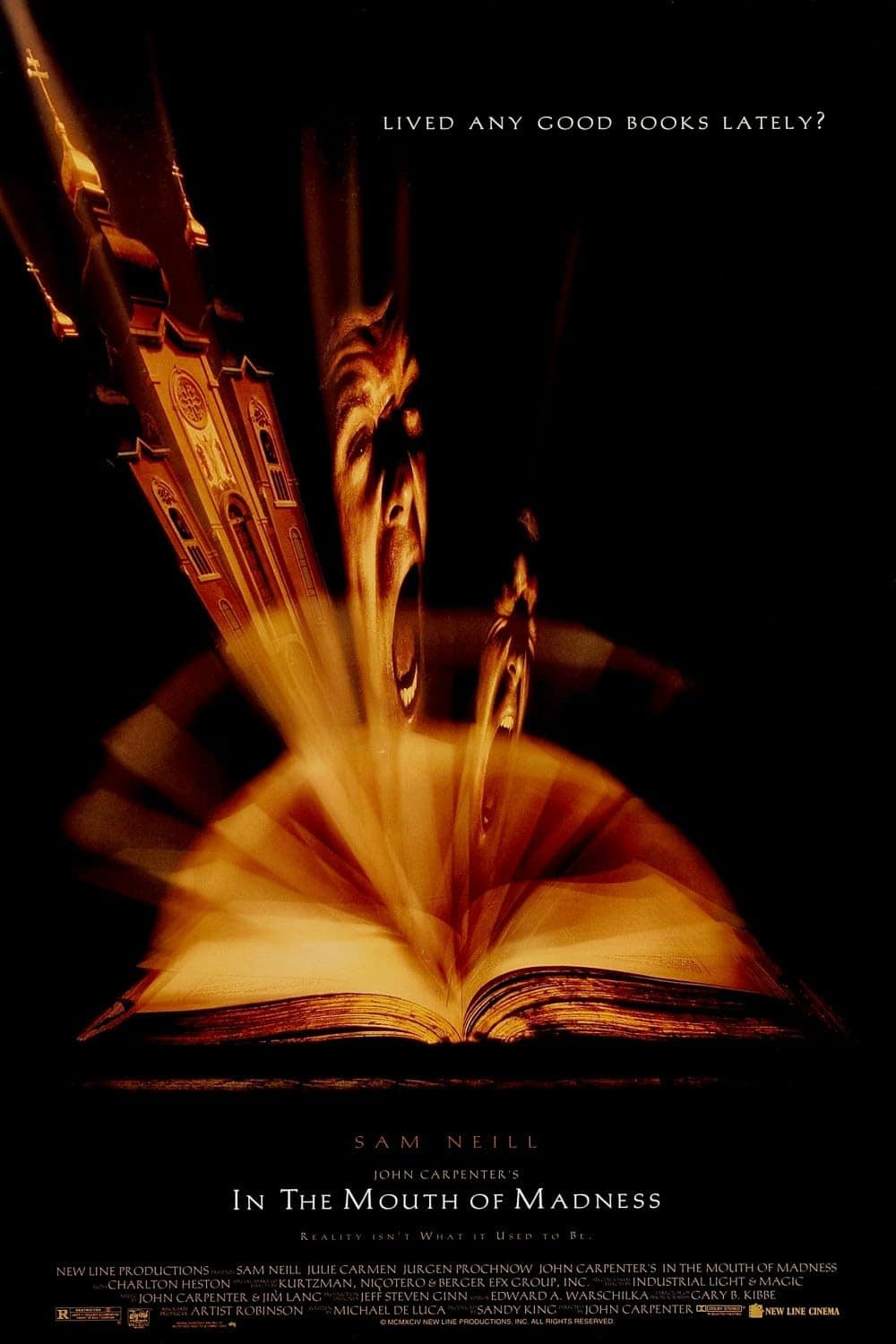
For this tribute, we dive into John Carpenter’s In the Mouth of Madness (1994), the final entry in Carpenter’s “Apocalypse Trilogy,” and a Lovecraft-inspired, reality-bending horror film built around books, belief, and cosmic dread.
We break down Sam Neill’s performance as skeptic insurance investigator John Trent, the film’s surreal structure, meta ending, and plot-heavy descent into Hobbs End, where fiction bleeds into real life.
We also highlight Carpenter’s signature direction and score, the stacked supporting cast (including Charlton Heston and David Warner), and the standout practical creature effects that make this one a pretty good.
In The Mouth Of Madness (1994)
Episode 502, 2 Guys and a Chainsaw Horror Movie Review Podcast
Todd: Hello and welcome to another episode of Two Guys and a Chainsaw. I’m Todd.
Craig: And I’m Craig.
Todd: Well, it is time for another tribute episode. We haven’t done one of these in a little while. Seemed like there for a bit we were doing one every other week. This July, last month, Sam Neill died at the ripe old age of 78 years old. New Zealand actor that probably most people recognize immediately from his big role in Jurassic Park.
Although he was in quite a bit of stuff. Hunt for Red October before that, Event Horizon we will see one of these days. I mean, we’ve seen it, but we’ve gotta do it- Yeah … here on this show at some point. And he got his start in horror, actually. Well, I mean, he got his start on the stage doing other stuff, of course, but as far as international breakthrough roles, he was in the third Omen movie-
Craig: Right
Todd: playing Damien. And then, uh, in 1981 was in Possession, which we did on this show, which was a very intense film that I still think about an awful lot, and I think his performance in that was absolutely fantastic. So yeah, so, uh, fast-forward several roles later, here we are in the Mouth of Madness, 1994, a movie I’ve seen a few times before this.
When I was a teenager, this had recently been released on video, and I think we probably rented it two or three times, and I know I saw it at least once or twice from a sleepover with some friends. And the thing that I remembered the most about it from that time was that I pretty much nodded off about halfway through each time I watched it.
I don’t think as a kid I really appreciated it as much as I do now. It’s definitely not that kind of fast action, spooky, jump scare horror movie that I was expecting, you know, when we were renting movies for these sleepovers. A little slower, a little long, a little bit of a, I don’t know, you could say cerebral in a way.
It just takes its time. I call it maybe a little more adult horror movie, I would say, based on the works of H.P. Lovecraft, which has his own mythos and his own style, too, and I feel like more or less this movie stuck to it pretty well. How about you, Craig? Uh, I’m sure you’ve seen this one before.
Craig: Yeah, a bunch of times.
But I think you’re getting jaded in your old age. An hour and 34 minutes is not long .
Todd: It feels long, man. The movie-
Craig: I didn’t think the movie felt long at all. Really? Like, I… Yeah. Ugh. Not at all. I still think it
Todd: felt long . I guess that’s just me.
Craig: Oh, gosh. I mean- I mean, it’s, it’s fairly action-heavy and, like-
vision-heavy. You think so? Uh, yeah. The, the… In fact, as I was watching it last night, because I, I told you this, but I, I… I’ll say it now for everybody else’s benefit. I, out of nowhere one night, decided I was gonna watch In the Mouth of Madness. I, you know, I was just scrolling, trying to find something to put on so I…
to, to go to sleep at night. And I came across it. I hadn’t seen it in a long time, so I put it on and I watched most of it. I did fall asleep before the end, but that was my goal. And then I woke up the next morning to a text from you that Sam Neill had died, and, and that was so weird. It was so weird to me ’cause I hadn’t r- I mean, we’ve talked about doing the movie before.
Yeah. But I, I hadn’t really given it much thought. I, I hadn’t really given Sam Neill much thought. I mean, I’m, I’m a fan. I’ve always been a fan of him, but I hadn’t given him a lot of thought in a long time. I knew that in fairly recent past years that he had had cancer and that it was bad, and they didn’t know if he was gonna make it through that, but he did, and I think that he’s been cancer-free for a little while.
So I was surprised. I was kind of shocked to learn of his death, though, uh, y- I think you said he was 78. I mean, that’s, you know, that’s a, a pretty good run.
Todd: Yeah,
Craig: it is. Um, I’ll, I’ll feel fortunate if I make it that far, but he seemed, you know… Cancer can get anybody, but y- despite that, he seemed vital and, and healthy and, and he was a cool guy, so sad to see him go.
Most people know him from Jurassic Park and of course I do, too. Dr. Alan Grant, I mean, it’s an iconic… Those are iconic movies. It’s an iconic character. I think he kind of cemented a legacy there. I, I, I think, you know, probably generations of people, our generation and our kids are gonna know who he is from those movies.
I knew him before that because inappropriately I grew up watching a movie called Dead Calm-
Clip: Hmm …
Craig: with him and Nicole Kidman and Billy Zane, and they’re basically the only three people in that movie and it’s more of like a psychological sexual thriller. Again, completely inappropriate for kids. But I grew up watching it.
And it’s a great movie, and he’s great in it. But I think that he’s been good in everything that I’ve seen him in.
Todd: Yeah.
Craig: Um, and beyond that, he just seems like… Well, I mean, he’s handsome and talented. He’s got those things going for him. But he just seemed like a really affable, kind, thoughtful person. And what I’ve seen, you know, people say about him, you know, people who’ve worked with him, it just seems like he was a very down-to-earth-
Todd: Scandal-free.
Craig: Scandal-free, you know, kind of a family guy. I mean, there’s cool stories about his family. I guess when he was a, a teenager or, or in his very early 20s, I don’t remember, he was very young, he and a, a young lady got pregnant and the, the baby was put up for adoption. But he looked for his son and, and found that his son was looking for him.
And as when his son was, like, 25 or something like that, they reunited and, and developed a, a, a solid relationship that was ongoing. And he, you know, he was just a cool guy. He owned a couple wineries. I think he was really chill.
Clip: Yeah.
Craig: But I think that he was just a good guy and a cool person to work with.
Laura Dern played opposite him, played his romantic counterpart in the Jurassic Park films, specifically the first one. And I don’t think at the time, I think looking at it in hindsight, some people have kind of questioned the age difference. I think she was only in her very early 20s, and he was already, I think, in his 50s.
So pairing them as a romantic duo was potentially questionable. However, she said that she just had the most wonderful time with him. She released a statement after he died, a very heartfelt and sentimental statement You know, commenting on their bond and, and how that would not change and stuff. So I, I, I think he was just…
I’ve just been a, a fan. It’s, it’s nice. You, you said scandal-free. And who knows? You never know what’s going on in people’s personal lives behind the scenes. But by all appearances, he really seemed to be a good guy, and it’s nice to have people that you can kind of look up to. And he, he was always that kind of guy for me.
You know, that’s, that, that’s what I aspire to. W- when I die, I just want people to say, “You know, he seemed like a pretty chill, good guy.”
Todd: Yeah, exactly
Craig: right. Some- somebody, somebody good to be around, no major scandals, not an asshole. That’s what I aspire to, and I think he accomplished it.
Todd: I- it seems like it.
You gotta die before that stuff comes out, you know?
Craig: Yeah.
Todd: Before people look too carefully into you. I– You had mentioned him and Laura Dern’s Bond earlier, and I– just reminded me that he was shortlisted for, uh, James Bond-
Craig: Yeah …
Todd: following Roger Moore. Timothy Dalton ended up winning out. But man, he would’ve made a good Bond, I think.
Craig: He really would have.
Todd: Really. He would. Uh, I would’ve liked to have seen him in that. But yeah, I mean, the dude’s got a hundred and s- um, almost 160 IMDb credits to his name. He was working right up until the end. He was filming something in Hawaii, I think, around the time that he passed. So yeah, he, he had a good run.
We’re gonna miss him. We’re, uh, anxious to talk about this movie because one of the reasons we chose this one, we could have chosen Dead Calm, but we decided that this one really focuses heavily on him as a big central character. And I have to go back and say that, you know, you said this is action, fairly action-heavy.
Craig: Oh, yeah.
Todd: When I said it was a bit yawning. And I just wanna say, I think there are different kinds of action, right? Mm. Like, there’s action that moves the plot forward. And in this case, there’s action– There’s a lot of action in this movie, but it really just takes, most of it takes place in the characters’ minds.
It’s a lot of visions and scenarios where you’re not quite sure if what you’re seeing is real or not. And so I think for me as a kid, and especially even just going back and watching it now, that’s the thing that kept this movie a little less scary than I would like it to be, I suppose. A little less, um, what I consider action-heavy because at the end of the day, it– Well, it’s, it’s not just about a guy going crazy and seeing visions.
And the– There are other people also going crazy and seeing visions. In fact, it’s like, sort of like the whole world is gonna end up this way ultimately. I- in many ways it, it’s reminiscent of, I think, even some Dario Argento movies that we’ve seen, and stuff from Italian cinema in many ways. I can see a lot of parallels between just the plot structure and the visual language, the cinematography, the usage of color, and I applaud John Carpenter for doing this because when you’re dealing with Lovecraft, this is the kind of stuff you have to delve into.
And this is, uh, based on not any particular Lovecraft story, I think, but, uh, it was written by, uh, Michael De Luca, directed by one of our absolute favorite directors, John Carpenter. John Carpenter was originally selected to direct it, and then a couple other people turned it down, and then it kind of came back around to him, and he agreed to do it eventually.
And he directed it and scored it, and I think it’s pretty recognizable as a Carpenter-type movie. You know, it’s got a lot of his, uh, fingerprints on it, his signature look, his signature style. I th- I’ve always enjoyed John Carpenter. I feel like he has a kind of no-nonsense way of doing filmmaking that is still very interesting and very fun.
He tells really fun, bold stories. I like that he unapologetically just goes out there with his ideas, and most of the time I think they hit their mark, and some of the times they don’t, and that’s pretty typical of every artist. So, uh, I just really like the guy. I really like everything he does.
Ultimately, I did enjoy this movie a lot more as a adult than I did as a kid. I think I just appreciated it more. I understood a little bit more what was going on, and the stakes felt a little bigger to me as an adult than they did as a kid Because as a kid, I came away from this movie thinking, oh, it’s really just about a guy kinda going crazy and ending up in the nuthouse.
But as an adult, I realize a lot of what the movie was about passed me by maybe while I was half asleep at a friend’s house at 2:00 in the morning after chowing down on cocktail weenies and, and sodas. We didn’t, uh, we didn’t have alcohol at our parties in high school.
Craig: Yeah. It’s, I mean, it’s not based on any one particular H.P.
Lovecraft story, but it, it definitely is inspired by that universe and, and directly references it multiple times. There’s an author who’s central to the plot. His name is Sutter Cane, which is a very thinly veiled reference to Stephen King. He’s like… He, he’s, he’s Stephen King. Right. Uh, e- except, except he writes almost exclusively, like, Cthulhu universe-type stories, and all of his books, the, the titles of the books that we see are all references to other Lovecla- Lovecraft stories.
And there are two or three instra- instances in the movie where somebody reads directly from one of his books, and I think every time it’s almost verbatim something from Lovecraft, tailored slightly to, to fit the needs of, of the plot, but almost directly from Lovecraft. And ultimately, there are Lovecraftian, like, creatures in it and stuff.
This was, I guess, Carpenter’s… He, he considered it the final film in his Apocalypse Trilogy, he called it.
Todd: Mm-hmm.
Craig: The Thing being the first one, Prince of Darkness being the second one. I haven’t seen Prince of Darkness in a really long time. I remember finding that movie
Todd: boring. Hmm. Me too.
Craig: But I haven’t seen it in a really long time.
But I didn’t find this movie boring at all. In fact, when I was watching it, I was thinking, “Wow, it’s gonna be hard to talk about this plot if we wanna go through it point by point,” because it’s plot-heavy. Like, it moves really fast. I’m just shocked that you found it slow. And, and the other thing that I’m shocked by is that you said that most of it happens in characters’ heads.
Like, that’s a take. Like Yeah. That’s, that’s a, a fairly subjective take. I suppose. Uh, I, I mean, that’s, that’s one way of interpreting it, I suppose. But I feel like aside from the fact that telling us that our narrator is crazy or at least perceived as crazy in the opening sequence, which it does The story is then narrated from what seems to be a pretty logical and objective point of view, and I think that that’s the point of it.
Like, we’re supposed to be, like, the, his character, John Trent, and, and he is, like, an insurance firm investigator. Like, he investigates claims or whatever. And so his character is very level-headed and always looking at objective truth and, and evidence and explanations. Like- Very skeptical … that’s his job, that’s his char- y- right, and he’s a skeptic- Yeah
of course. That’s the lens. We’re viewing it through his lens, and so it’s all presented in here’s what I see, here are, you know, here’s how I can interpret what I see through the lens of reality. Which is kind of the point because then at the end, I mean, that’s kind of the whole point of the movie is this existential, you know, what is reality?
Todd: Yeah.
Craig: But to say it, I, I, I think to say that it happens in his head is a little misleading
Todd: Okay. It happens to him and him alone. Sometimes him and this other girl alone, or this other girl alone. And so much of it is very dream-like, very surreal. You- there’s dream within dream within dream sequences in this movie where something will happen to him and then he wakes up, and then something else happens and he wakes up from that.
I mean, that happens two or three times in here. So I feel like Carpenter is really trying to blur the lines a little bit. Yeah, I see what you’re saying. By the end of the movie, you can be like, “Oh, yeah, this stuff really did happen to him.” But how much of it did? How much of it happened to him, and how much of it was influenced by these things?
I mean, there’s no question there’s something happening. There’s no question he’s being influenced. You know, this is, this is the Lovecraft thing. And actually, this is why I really appreciate the movie now. I think Carpenter did a pretty excellent job of doing a Lovecraft-type movie-
Craig: Oh, for sure …
Todd: which would almost read better on a page than it does on the screen, except he does it so well on the screen that also he does a good job of it.
I, I’ve played… I, you know, I, I’ve only read a few stories of Lovecraft. I think you, you’re kinda the same, right? Like-
Craig: Yeah …
Todd: w- we’re not really steeped in this, but I am still sort of steeped in the after lore, I suppose.
Craig: Right. Same.
Todd: He created a universe, and now there’s been a lot of stuff, people adding to that, people developing their things in there.
I’m such a nerd that, uh, I have friends who are really into gaming, and, and I’m talking like tabletop gaming and role playing and things like that, Dungeons & Dragons type-esque stuff. And I’ve been in a few of these Call of Cthulhu type sessions. I’ve played quite a few of these Cthulhu-based board games.
Some of them are really, really fun. And, you know, they all, they’re always like this . Like, there’s an insurance… Just the fact that he’s an insurance investigator made me smile. Because who would ever think that their main character of their show that’s gonna go into horror or whatever would be, like, an insurance investigator, you know?
It, it’s not often that interesting things happen to those people, I suppose. Although, when you think about it, actually probably a lot of interesting stuff happens for insurance investigators ’cause he’s kinda like a detective in a way, right?
Craig: Yeah.
Todd: And there’s so many times in these Cthulhu board games, in these Cthulhu role playing games, and I can then only assume in H.P.
Lovecraft’s work, when a, the main character is an insurance investigator.
Craig: Well, that’s what I was gonna say. Like, a- again, I, I am in the same boat as you. I am more well-versed in the stuff that’s inspired by Lovecraft than I really am in Lovecraft himself. But, you know, in the stuff of his that I’ve read and the stuff like Re-Animator and other, you know, lots of other stuff that I’ve seen that’s inspired by his work, this seems typical.
You’ve got A narrator who is an average Joe, who then gets thrown into this crazy irrational world, and we kind of see it through their eyes. Like, we, we just did Color Out of Space, right? Right. So the, the WPA guy i- is that guy. You know, he, he’s telling the story, “Oh, well, here’s the weird thing that happened.
I’m a rational, you know, water guy.” Right. And, and then, uh, in, again, it’s been a long time since I’ve read the story that inspired it, but Re-Animator is told, like, it’s not told from the crazy doctor’s perspective, it’s told from, like, a normal- The
Todd: intern or whatever
Craig: the- Yeah, the intern- Or the student … or a student or something.
Students,
Todd: universities, yeah, uh-huh.
Craig: So, so this is fairly typical. So you take kind of an average Joe and, and throw them into this illogical world. And, uh-
Todd: Yeah There’s something to investigate. There’s, like, a mystery to solve. A- and that works well for an insurance investigator. I mean, they’re always being sent out to solve the question of, is this le- legitimate claim or is this person fraudulent?
And we open up with him being crazy, but as soon as, uh, as we pr- jump into the past, it’s a flashback sequence, uh, we learn that he is just the hottest, best, most perceptive and slick insurance investigator that his buddy has ever seen, you know? He’s just top of his game. He can detect bullshit a mile away.
Clip: Trent, you are beautiful. Everybody says you got the best nose for con in the business. But to see it firsthand, I mean, to watch you work is incredible. Well, it wasn’t hard, Robbie. The guy’s wife liked me. Besides, he was an amateur. It’s just too easy with amateurs. See, you try to figure out who’s professional and who isn’t, and, uh, that’s when it gets fun when you’re Run into a pro.
You know, most of my salesmen couldn’t sniff out a phony claim if their noses were nailed to it, but you, man- Out of my way … you never miss.
Todd: And so he’s the ideal candidate for a guy who’s gonna be tested and is gonna be questioning reality.
Craig: Yeah, and Sam Neill plays that very well. Like you said, I agree with you.
I think he would’ve made a great Bond because he’s just very charming and smooth. And yeah, I buy him as a slick guy that you can’t get anything by. And that’s set up in kind of a cheesy way, but, but the prologue or, or the opening, I mean, is important because it establishes that we see him initially getting pulled into this, like, secluded, gothic almost looking, um-
psychiatric facility.
Todd: Nuthouse.
Craig: Yeah. And I mean, it’s like Arkham or something. I mean, it’s not- It’s crazy … as dark and gothic as, like, Arkham Asylum would be, but it’s reminiscent of that.
Todd: I know. As soon as I saw him in this l- situation, realizing this had to be a location, you know? I mean, it had to be a practical location.
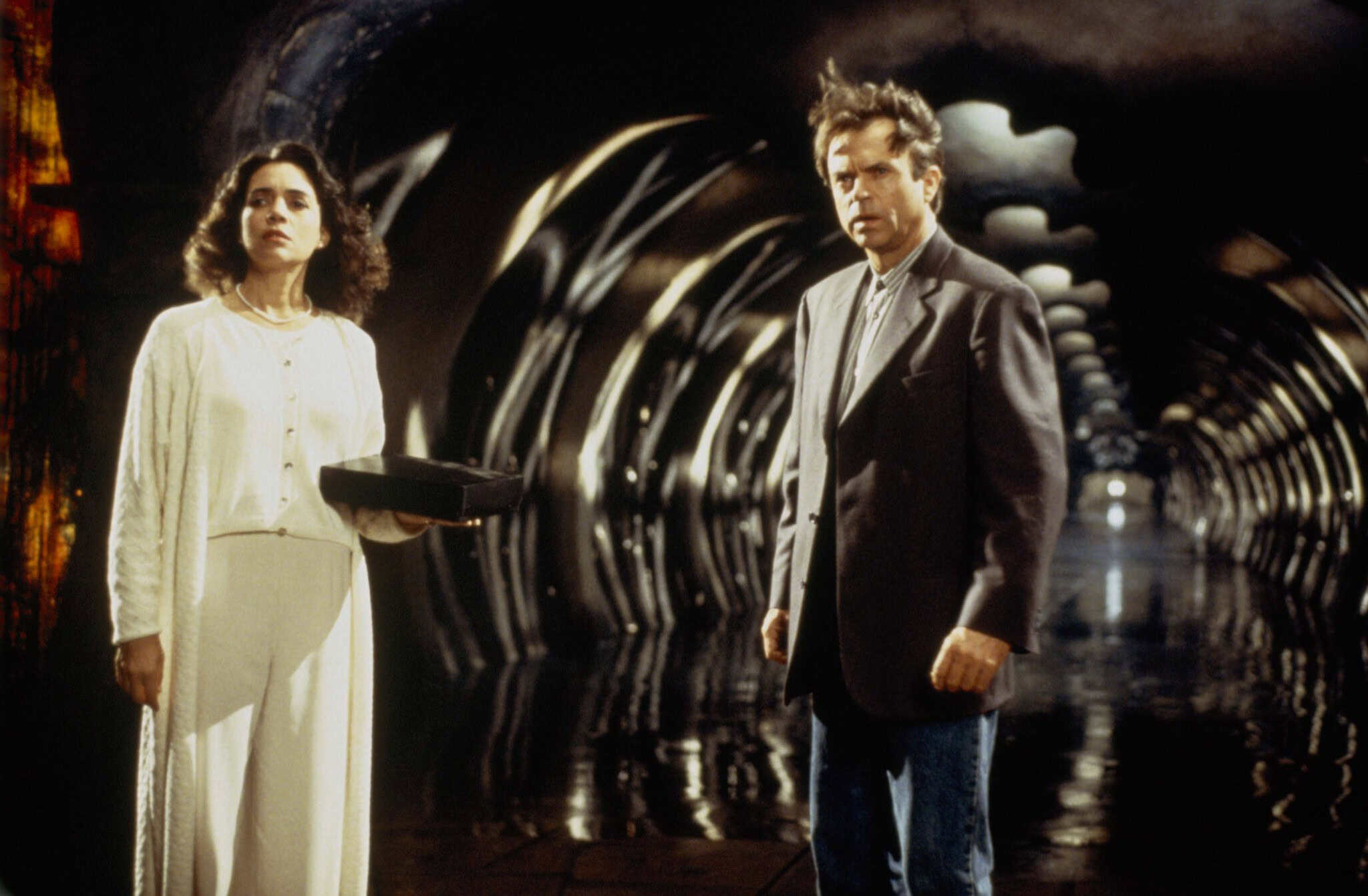
I was like, “Where is this filmed?” It was filmed in a water treatment plant, which … And it, I guess it kinda makes sense. I don’t know, it’s got these tall ceilings, this weird, like, tower-like structure in the middle of a bit of an atrium and- These long corridors with these… I mean, what a crazy-ass building this is.
Craig: Yeah.
Todd: It was really cool.
Craig: And it looks fantastic. I mean, there’s a lot of great set pieces in the movie and, and some of them, like actual locations. This is one of them. There’s another really cool one later. But he gets… The another thing about this movie, gosh, like, I don’t know. I, I thought that this was gonna be a movie that we were both gonna nerd out over because there are so many things to nerd out over.
Mm. Like, y- I mean, the, the fact that John Carpenter directed it and scored it, I mean, that alone is, is huge. Sam Neill is great, but then there are so many other great and recognizable people in this movie. Oh my God, yeah. Like, even in small roles. Like, when he, when he gets dragged into this asylum, the guy that checked him in is played by John Glover, who we’ve seen.
He was in… He was the smarmy guy in Scrooged. He was in Gremlins 2. He was the smarmy guy in Gremlins 2 . He’s always the smarmy guy in something.
Todd: Wasn’t he the smarmy guy in Office Space or, or was it just a guy who looked a lot like him?
Craig: It was a guy that looked like him. Uh- Oh,
Todd: God, yeah … but he- I imagined him in Office Space.
Craig: I think I also just recently saw him in something, I think it was called The Ward with Pete Davidson. I think he was in that recently. But he gets in there and then, and then the doctor that comes in to, I don’t know, assess Trent, Sam Neill, is David Warner- Yeah … who we’ve seen in a bazillion things.
Todd: Yeah.
Craig: Waxwork, right? Wasn’t he the- Right, one of
Todd: our earliest ones that we did. Yeah, Waxwork.
Craig: Uh, yeah. And he was Billy Zane… Gosh, two Billy Zane mentions in one episode. Billy Zane’s, like, lackey in Titanic, I think. Like, this guy’s been everywhere.
Todd: Wasn’t he in Company of Wolves with Angela Lansbury? I was thinking
Craig: he was in that.
I think so. That sounds right. And I mean, while I’m looking at the IMDb page, just
Todd: to- Might as well. Rattle it
Craig: off. Uh, Bernie Casey, I don’t even remember when he shows up and I’m like, “Hey, there’s that guy from Lean On…” Or no, from… Maybe he was in Lean On Me too, but he… I think he was in Revenge of the Nerds.
He was Dean Warner or something in, in, uh, Revenge of the Nerds, I think. Charlton freaking Heston is in this movie. Like-
Todd: Oh my God, when he showed up, I was like, “Oh my God.” And he’s got a small role. It’s so nuts.
Craig: Nobody’s great in it. He is. He plays, like, Sutter Cane’s publisher.
Todd: Uh-huh.
Craig: And Sutter, Sutter Cane is the biggest author in the world in this, in this movie- Right
which, which really isn’t, you know, much of a stretch. I mean, Stephen King really is huge. But I would imagine that the biggest author in the world, the top-selling author in the world, would have this kind of executive-
Todd: Yeah …
Craig: publisher, you know, like, i- in a sky rise office. And, and Charlton Heston just, I mean, just is a presence.
I di- I didn’t, you know, necessarily agree with all of his politics and stuff like that, but you can’t deny the guy is a, a screen legend. And then there’s other people that pop up too, like Wilhelm von Homburg is one of the residents of this small town that they end up in, and he was Vigo from Ghostbusters II.
Mm-hmm. I am V- Vigo.
Yeah. God, I love that movie. The, there’s a, a little inn, and the little old lady innkeeper is Frances Bay, who is this little old lady, again, that you’ll recognize from virtually everything. She was Adam Sandler’s grandma in Happy Gilmore.
Clip: Mm-hmm. “My fingers hurt.”
Todd: Oh,
Craig: I love that movie. And then the, the romantic interest, Styles, she works for the publication company, and she, when they send Trent on this investigation to find their main author, ’cause he’s gone missing, she has to go with him to make sure everything’s on the up and up or whatever.
She’s played by Julie Carmen, who I don’t know from a lot, but I certainly do know her as Jerry Dandridge’s sister in, uh, Fright Night II.
Todd: Hmm. Yeah.
Craig: Which, have we done Fright Night II?
Todd: No, we’ve only done the first one. I… You know, I’ve never- Oh, man … even seen Fright Night II, actually.
Craig: Oh, well, you would like it.
Todd: I would. I bet I would. I love the original.
Craig: Sexy vampireesses, and she is, uh, the lead one, I believe.
Todd: She was all over TV, yeah, it’s
Craig: every- Yeah, I mean, but it’s just chock-full of people that you’re going to recognize. And, and gosh, just overall it’s well done. I actually think of this- I’m surprised that this movie isn’t more esteemed or, or well-remembered than it is.
In our book club, our, our, our friend Joan was just telling me last week how she had never seen it before, and she was inspired to see it by the passing of Sam Neill, and she thought it was great. I don’t even know how y- many of our listeners will have seen this movie. And I’m not trying to jump to the end or anything.
There’s a lot to talk about. But maybe, maybe if you haven’t seen this, I definitely 100% think you should. Yeah. And it might be more fun… I mean, we’ve already talked a lot about the essence of it, but as, as we get more into specific plot points, it might be better if you, if you watch it first and then come back.
Todd: Yeah. I, I think so. But I think ultimately it… You’re right in a way. I don’t wanna say it hasn’t stood the test of time. It’s just not as well remembered as so many of John Carpenter’s other films, which is odd considering its pedigree, I think is what you’re kinda saying. And not just its pedigree, but, but it’s legitimately a good movie.
I think, in a way, maybe because it, it’s a horror movie, number one, from the early ’90s, that wasn’t a slasher, didn’t spawn a big franchise or anything like that, and I don’t think ultimately brought a lot new to the table. There’s not like a hook in here that’s gonna be like, “Oh my God, that’s that movie where that one thing in it, like, blew my mind.”
And so I feel like it probably got lost in the shuffle along with a lot of other things.
Craig: Well, I think it maybe, I think it may be a little bit cerebral. I think that even in the world of horror, and you and I have alluded to this and admitted that this is part of what keeps us away from it, is that Lovecraft himself is a little bit heavy.
Yeah. And not academic, but it’s not a, it, it’s not light reading. Lovecraft is not light reading.
Todd: No.
Craig: And so there’s that, and then ultimately it’s a, it’s a movie about reading. It’s a movie about books.
Todd: Right.
Craig: So if you’re not a big reader- That’s true … that might not appeal to you. But I do think that it’s really unique in its premise, and I think it’s really clever in its premise.
But you kinda, I mean, you have to get to the end- To unwrap what the premise is
Todd: Right. And I don’t think it’s spoiling anything of our conversation to just say this is very typical Lovecraftian stuff, which is not in your face horror jumping out at you, jump scares, final girl running away kind of stuff typically.
What we’re talking about is there’s this notion that there’s another plane of existence, like a dimension around us that is imperceivable and imperceptible to us because we are so small. Humans are just nothing. We’re like ants to the greater, older beings that inhabit this universe, and they’re bigger, and they’re more powerful, and they can be nastier in a way that we can just swat a bug away and not think anything of it.
That’s what we are to these creatures, and occasionally they poke through to our world, and most of his fiction and most of the stuff that kind of comes after it is the stories of when that happens Or if there are entities in this side deliberately trying to push through, through certain channels and, you know, occult channels and occult ways.
And that’s kind of what this movie is about. And so it is a deep, lingering, s- unsettling unease that these people, I would say, traverse through more than, “Stuff’s happening, they’re running away. This is happening and they’re running away. This is happening, they’re trying…” You know what I mean? And I think, again, that’s
It’s just different from a lot of other horror movies where you’re expecting jump scares every five minutes. I mean, w- when you, when you look at it, a lot of this is Sam Neill reacting to things that are happening to him, but in a very measured way you know? And maybe it’s because he’s skeptical or whatever, but, like, his character, like some crazy shit’s happening, like, right in front of him, and I would be just flipping out and running for the hills.
And there are times when he’s just sort of like, “Oh, this is interesting. Let me check it out more.” You know? And there’s so much
Craig: of the- I think we watched different movies. Really? Because I
Todd: d- Okay … because s- because he
Craig: was the w- I… There’s nothing- He’s
Todd: remarkably calm through this.
Craig: He’s only remarkably calm until stuff that defies reason begins to happen.
He’s constantly looking. He thinks it’s all a hoax-
Todd: Yeah …
Craig: from virtually the beginning. N-
Todd: He thinks he’s seeing things probably too and, and stuff, and so, yeah, I’m-
Craig: But, but even before th- he doesn’t really see anything that couldn’t be logically explained in some way until the last third of the book when virtually everything is revealed.
And at that point- Right. He goes crazy … he does start freaking out. Like you t- you, you talk about measured responses. I w- and I… My first thought was, “Oh, you mean like screaming maniacally? That is the measured response?”
Todd: By the end. But, but I mean, we go through an hour and 15 minutes before we get to that stuff.
Craig: But right, but that’s up until the point where he actually starts to see things that cannot be explained.
Todd: Right. But it takes a while to get there.
Craig: W- sure. The, the movie takes a while to get there. Yeah. I just don’t know that he takes a while to get there once… I mean, he… Okay, so what… So all right. So Sutter Cane is this huge l- literary giant.
Literary maybe not the right word, but popular writer. Writes horror novels, hugely popular, but he’s gone missing and so they hire this insurance investigator, I guess, to find him because whether… They don’t really care whether he’s okay or not. They don’t really care whether he comes back or not. But they are on deadline for his next book, and they gotta get it out, and so they want him to get the book.
So he starts doing investigations Even before he gets called in to do this, there’s a strange event where he’s talking to a f- somebody about this author for some reason, and a maniac with an ax bursts through the window, the plate glass window of the restaurant that they’re eating at, and the guy leans over Sam Neill and says, “Do you read Sutter Cane?”
Immediately after that, he gets called into this thing, and we also find out that that guy who attacked him was Sutter Cane’s agent and the only person who has read the new book that’s supposed to be coming out.
Todd: Right.
Craig: Sam Neill starts investigating, and part of his investigation is he starts reading all of Sutter Cane’s books.
And in doing that, then he kinda starts having weird nightmares. Or nightmares or, I don’t know. Styles, the, the lady who works for the publication company, she tells him that part of the reason that Sutter Cane’s books are so popular is because they have strange effects on people. It affects people’s sleep.
It affects people’s, like, concept of time or something. I don’t know. She explains it all, but it sounds like it’s, like, a trippy experience, and Trent is intrigued that people would want to feel that way. But when he starts reading the books, he starts kind of experiencing weird things, too. Like, he has this weird moment where he walks by an alley and he sees a policeman beating a vagrant, and then he re-experiences that a couple of times through what ultimately appear to be dreams, but the cop is, like, disfigured and, uh, Lovecraftian kind of in his fantasies.
And so the lines between reality and, I don’t know, unreality are, are blurred. Ultimately, he figures out that if you take apart all of the covers of all of this guy’s books and cut them up along these lines on the covers, it forms puzzle pieces that form a map that lead you to a town that appears in his books called Hobb’s End that doesn’t appear on any regular maps, but it must exist, so they’re gonna go look for it, and they do.
Todd: Yeah. And, and, uh, the publisher sends Miss Styles along with him. They’re gonna try to hunt them down. So they go on a car ride, and it’s through just fields and things. And again, they’re-
Craig: And there’s-
Todd: They’re having
Craig: visions and- I was just gonna say she is kind of having visions, but it’s on this car ride, and I could see how people could find this boring, but I find it interesting.
He’s talking about why … And I, you know, this could just be a conversation between anybody about why people like horror. It’s a conversation that you and I have had dozens of times.
Clip: You’re the Cane lover I just like being scared. Kane’s work scares me. What’s to be scared about? It’s not like it’s real or anything.
Well, it’s not real from your point of view, and right now reality shares your point of view. What, what scares me about Kane’s work is what might happen if reality shared his point of view. Whoa, whoa, whoa. We’re not talking about reality here. We’re talking about fiction. It’s different, you know? A reality is just what we tell each other it is.
Sane and insane could easily switch places if the insane were to become the majority. You would find yourself locked in a padded cell wondering what happened to
Craig: the world. Obviously foreshadowing what’s going to happen and ultimately what we’ve already seen.
Todd: Yeah.
Craig: And that’s one of the things that I like about this movie, is that it’s not overly intellectual in its approach, but I think that it’s an interesting approach to the idea of existentialism and what is reality.
And it basically, it posits that reality is subjective and that we may not be in control of our own destinies, which is You know, again, you know this, but I’m reminding the people who might be listening who might be new to us, I’m an English teacher, and so I teach stuff like Kafka and, gosh, I can’t think of any other existentialist off the top of, of my head.
But we talk about how, how much of reality is perception, and we get into existentialism and nihilism and all that kind of stuff. So this is interesting subject matter for me. I guess if you don’t find that particularly interesting, I could see how you would find the movie boring.
Todd: Yeah. I, I mean, and it’s core to Lovecraft’s universe really.
The, it’s all based around this idea that our perception of the universe is limited. You know? Like, we can only see three dimensions. We can’t see ultraviolet light like dogs and other creatures can. You know? There’s a whole realm of the senses outside of what we’re able to experience, and that’s where the more interesting stuff is, the stuff that’s bigger than us, the bad stuff, at least bad to us stuff.
And if we were to be confronted with it, our minds just can’t really comprehend it, and so they snap, and that drives you insane. I mean, almost every- Right … Lovecraft thing ends with somebody going insane because they’ve had an encounter with one of these creatures. Yeah. And so yeah, like, that’s kinda the core of the whole thing.
And, and so it- it’s, it’s very true to form in that way. And you’re right, it presents it in this nice little bite-sized way that people can, can digest. I guess maybe I didn’t find it so interesting because this is nothing new to me. This isn’t mind-blowing philosophy and concept, so I, I did find this kind of, yeah.
I, I’m like, “Okay, that’s, that’s cool. I get it,” you know.
Craig: There’s definitely a big… Yeah. There’s definitely a big talky moment here, and there’s talky moments later, too. There’s a big, not exposition dump, but a big scene where when they eventually do find Sutter Cane, he talks for a long time about the nature of reality and all that stuff, too.
So it definitely does have those slow down talky moments that could potentially break the pacing, I suppose. But on this car ride, she starts seeing weird things. She sees a young kid riding down. I mean, this, it’s pitch black at night. Sh- all she can see, uh, are the lines on the highway. She sees this kid ride by on a bike, and then just moments later she sees the same bike, but it’s, like, some weird decrepit old person on the bike.
And then she tries to wake Sam Neil up ’cause he’s sleeping, and she’s not looking at the road, and then she hits the old guy on the bike. And, and the old guy speaks in a kid’s voice, and he’s like, “They won’t let me leave,” or something like that. I don’t know. Very ominous. They keep on driving and she has more kind of hallucinations, and it almost seems like she’s driving through some sort of portal or Stargate.
I don’t know. There’s like flashing all around her, and at some point she either opens the door or looks out the window and it looks like the car is, like, flying above the clouds.
Todd: Yeah.
Craig: But ultimately she just comes out on the other end out of this covered bridge, like an old-fashioned wooden covered bridge.
And then Sam Neil wakes up and is like, “Oh good, we’re here.”
Todd: Yeah. It’s daytime. It’s very jarring.
Craig: And then they go looking around this town, and what’s interesting about this town… Now again- Ultimately, he thinks that this is a, an elaborate hoax that they have set up because everybody… It, it’s, it’s super quaint.
They drive into, like, the town square, which is like, you know, Children of the Corn, Something Wicked This Way Comes, like quaint Midwestern downtown, and he even comments. He’s like, “Oh, this is cute.”
Todd: Yeah.
Craig: But there’s nobody around. It’s like a ghost town, and we see, like, a bloody ax, but they don’t see it. She sees, like, a group of kids chasing a dog, but she asks him if he saw it and he doesn’t.
So there’s something weird about the town. They go to this little inn, and as soon as they go to the inn, she realizes not that she’s been there before, but that she’s read about it. She realizes that everything in this town is stuff from his books, and she knows it down to the detail. She knows that there’s a creaky board on, in the floor.
She knows what painting is supposed to be hanging on the wall. She knows, you know, who the innkeeper is supposed to be, all of this stuff. But again, he thinks it’s either just a coincidence or maybe Sutter Cane is writing about this town, so he was inspired by these people or whatever. But it just keeps getting stranger as time goes on.
In fact, he says, “It, you, you know, it’s gotta be fiction because if I were to open this window,” they’re in the hotel room, “If I were to open this window, there should be, like, Byzantine cathedral out there.” And he opens the window and there’s nothing there. He’s like, “See?” And she’s like, “Nope, you got the wrong window,” and she opens it up and-
there it is.
Todd: Big Byzantine church. Yeah. That’s funny.
Craig: Which again, apparently this church was an actual location that was just this huge, weird Russian cathedral in the middle of nowhere.
Todd: Right?
Craig: That was a crazy location. Yeah. It was wild. Looked really cool.
Todd: It did look cool. Yeah, I mean, he goes up to the church and they look like they’re interested in going in, but then suddenly there’s some commotion behind them and all these guys are coming up in trucks.
And she senses danger and they run away, and these guys leap out of their trucks with guns. And they go up to the church and they’re banging on the door and, and they’re asking, I think, for the author, right?
Craig: Yeah.
Todd: And then these, these big Dobermann come running around which, you know, at this time the Dobermann were the big-
Craig: Uh-huh
Todd: scary dogs of the era. Late ’90s, early ’80s. All right, late ’80s, early ’90s, Dobermann Pinschers were the worst. They come around and so then there’s kind of this battle, and the doors swing open of the church, and there’s this little kid in there. And I don’t know if it’s supposed to… Was it supposed to be the kid from the bike?
Craig: No.
Todd: Okay.
Craig: We don’t know what’s going on at this point. This, an angry mob is trying to get th- their kid back from the author- Mm-hmm … and the author is there. Sutter Cane is there. He appears in the doors of the church or whatever, but then he sics the dogs on them. And they, the two main folks, run away and go back to the hotel- Again, he thinks it’s a big prank and they’re all in on it, and it’s all acting or whatever, but she says, “No, this is the plot of his new book playing out in real time.”
Todd: Yeah.
Craig: And she’s- she says, “The reason I know that’s true is because it was supposed to be a hoax. We were trying to hoax you, but none of this was in our plan.”
Todd: We just sent him away and told him to stay quiet.
Craig: Right.
Todd: Yeah, that was the o- that was the extent of the hoax we had planned.
Craig: Right. And she says, “In this book, this book is about a town that gets taken over by an evil force, and it starts with the kids,” and that’s what we were seeing, I guess.
Mm-hmm. “It starts with the kids, but then it spreads to everybody, and it’s a, it’s about people turning into other things,” like these tentacled things or whatever, Lovecraftian things. And she is totally invested and believes this now, but he is still skeptical. I don’t remember why they separate, but he goes out to a bar where the main local who was at the church with the gun is in the bar and says something along the lines of, “What’s weird is I can’t remember which came first, us or the story,” or something like that.
And then he puts his shotgun under his chin, and Trent says, “Don’t, don’t do that.” And he says, “I have to. He wrote me this way,” and he blows his head off. So I guess at this point, Trent either knows something is going on or at least wants to get the heck out of there, so he tries to get out, but he can’t get out.
Every time he tries to leave town, he just ends up looping back in. And, and then he, like, drives through a mob of mutated townspeople, and Stiles, uh, is there, but I think she’s kind of one of them at this point.
Todd: She has a whole moment where she goes into the church. She encounters some kids, and there’s some freaky-looking kids who say, “You’re my mommy.
You know what today is? Today is Mom’s Day.” And there’s an upside-down cross in there, and she sees… Eventually, both of them end up seeing the author, the author himself.
Craig: They, i- yeah, they end up, I think… I don’t remember how. It’s all very… I, I, I think he, like, blacks out and just wakes up in this room.
Todd: Yeah. I think you’re right, actually.
Craig: And she’s there, too, and the author’s there, and he’s, like, writing. But it’s not just a room. It’s a really weird… It’s surreal. It, it almost-
Todd: Yeah …
Craig: I don’t know. It’s
Todd: hard to
Craig: explain.
Todd: It’s like a, an area of the church or something, I, I suppose. Mm-hmm. Like, that’s his headquarters or something.
Clip: You can edit this one from the inside, looking out.
It’s funny, isn’t it? For years, I thought I was making all this up. But they were telling me what to write
Power to make it all real
Now it is All those horrible, slimy things trying to get back in
Todd: You know, like into our dimension, in… Like, his, his writing is the conduit through which, you know, people will read it and it will enable the demons or the, you know, the otherworldly creatures to get through. And that’s visualized here by this pulsing door behind which is, uh…
You know, it’s this black stuff. You know, I, I’m thinking about that now, too. Wasn’t there another Carpenter movie where they had to visualize some creatures trying to break through, and Carpenter was like, “The best I could do was this, just cutting in these bits of the pulsing door,” and he was afraid it, it’d end up maybe looking a little cheesy.
Do you remember that? What movie was that? No.
Craig: I don’t know. I don’t remember.
Todd: There, there was a whole thing about it. It’s like the second time… Oh, oh, um, it was The Fog. I think it was The Fog. Anyway, look, I, I get it. There is stuff happening to them, but it’s all just so surreal, and it’s so unclear if they’re- But, well, he-
in a dream world or if they’re in the real world.
Craig: They’re not in a dream world. What he says is, you know, again, there’s this whole discussion about what is reality, and he basically says that for so many people, religious faith is reality because they read it and, and, you know, he, he says, “More people will read my work than will re- and read it and believe it.
And if when they read it and believe it, that makes it real.” And he kind of blows Trent’s mind by say- basically saying, “You are a pawn. Like, I wrote you. You are just a character in my book.” And of course, Trent wants to reject that. But he’s like, “Yes, you know, you’re a character. I needed you. I needed somebody.
You are going to be my courier,” or something like, “You’re, you’re going to deliver my manuscript to the publisher so that it can be published and, and put out there in the world.” And then he’s standing in front of that door, you said, that seems to be, like, holding back whatever. But instead of opening the door, he reaches both hands up to his face and tears the, the
Todd: The fabric of reality,
Craig: really . The fabric of reality as- Yeah … right, as though, as though it is pages of a book. Like, he peels it back to reveal on the other side words, as though it’s pages, and just a black abyss beyond. And then as it tears open, he disappears w- within the tears and it, and it’s this big open rift.
And Trent walks up and looks into it, and Stiles reads from the manuscript. And again, it, it comes mostly from, from Lovecraft, but it talks about looking into the black abyss and the, the unimaginable terrors beyond staring back at you and, you know, uh, pouring upwards towards our world and blah, blah, blah.
And then so he sees these things. We don’t see them initially, but as they come through into our reality or his reality or wherever they are- He’s in this giant tunnel and, uh, he’s running down the tunnel, and these things are behind him. And this is shot in a really interesting way, and I remember, you know, soon after this movie came out, I saw a making of somewhere- Hmm
or I saw it in Fangoria Magazine or something. But this was a huge special effect. I noticed that Gregory Nicotero was on the effects team of the film. But what they did was they built this huge, uh, piece. It was basically like a wall that was covered in all of these different creatures that could move.
Some of them moved and articulated on their own, but it was like 18 feet tall, I think, and I don’t remember how wide it was, but it was huge. And it was all on a track A- a- and it had to be pushed. A- as Sam Neill ran in front of it, it was pushed from behind to be following him. And the way that we see it initially is the camera is facing him as he’s running towards the camera, and we can just kind of see it in soft focus in the back.
But it cuts to some close-ups of the various components of it, and it looks really cool, and it’s a really cool practical effect. I don’t know. Again, it’s just one of the many, many things that I like about the movie. But it chases him, you know, and he trips and falls, and just as it’s about to overtake him, he wakes up in broad daylight, you know, in the street right outside of town.
Todd: Yeah.
Craig: And a kid on a bike, you know, rides by. I didn’t realize it was Hayden Christensen in his-
Todd: Oh …
Craig: film debut.
Todd: I did not know that.
Craig: I, I would- I read it. I never would’ve noticed. But basically, he’s like, “Uh, yeah, I’ve never heard of Hobbs End, mister. Highway’s that-a-way.” So he goes and he gets on a bus back to town, and then it becomes apparent right away that Sutter Cane is still fucking with him.
Um, appears to him on the bus, turns everything on the bus blue. A- and again, it’s at this point that he’s… that, that Trent is really losing it. When he wakes up from his dream of talking to Sutter Cane on the bus, everything… You know, Sutter Cane says, “Oh, by the way, did I ever tell you my favorite color was blue?”
And then he snaps, and Sam Neill wakes up, and everything on the bus, including all the people and stuff, is blue, and he screams and freaks out. Yeah. And then I don’t… All I really remember, uh, he, he, he freaks out and he burns the manuscript and totally destroys it.
Todd: Yeah. Then he goes to the publisher and has finished telling his story, and the publisher’s like, “Well, that’s a pretty fantastic story.”
And he’s like, “Yeah, you, you know, you can’t publish the book. You can’t… Nobody can read it.” And he’s… “And I burned it, so nobody will.” And he says, “No, that’s not true. You delivered it to me, like, w- like, a month ago.” In fact, uh what does he say? It’s
Craig: on the
Todd: shelves. He says, “It’s just… It’s on the shelves now, and the movie’s coming out, like, in three weeks.”
Yeah. And also, he mentions Styles, and he’s like, “I don’t know who you’re talking about. I never sent you there with anybody. You, you know, you went on your own.” So it calls into question whether she even existed, I suppose, or is this him messing with her, too? You, uh, you know, it- it’s just all… You, you don’t really know But, uh, he’s going crazy, and he even goes to a movie theater, and he’s watching the movie, and we see the movie.
Oh, I’m sorry.
Craig: Well, that’s, that’s, that’s the very, very end. Before that, he goes out and he sees that people are, you know, everybody’s … There’s hysteria, people in lines to buy the book, and you can- you overhear newscasts about how there’s this global epidemic of psychotic outbreaks, and people are attacking other people violently, and it’s, you know, terrible, and people are dying, and blah, blah, blah.
And he sees a kid on the street coming out of the bookstore, and he asks … And the kid, his eye, like his pupils are split. We’ve seen this in people before. It’s the effect that, that reading this has on people. His pupils are split, and he’s like bleeding from his tear ducts. And Trent asks him, “Do you read Sutter Cane?”
He’s like, “Yeah, I love Sutter Cane.” And he says, “Okay, well then this won’t surprise you.” And he pulls out an ax, and he kills the kid with an ax.
Todd: Yeah.
Craig: Wh- which is what gets him locked up in the mental institution, where he’s telling his story to this psychiatrist. And he says, “It’s getting pretty bad out there, isn’t it?”
And this psych evaluator or whatever is like, “Uh, yeah, I don’t know what you’re talking about,” blah, blah, blah. But when the guy, the evaluator goes back out into the hospital, we don’t really see what happens, but we hear. We’re, we’re with Sam Neill in his cell. We hear viol- the lights go out and violence- It’s like bedlam out there.
Yeah, somehow. Yeah, it’s, yeah, it’s bedlam. But he just stays in his cell, and the next morning he comes out. I don’t know if he was spared because he’s, you know, drawn crosses all over his cell or whatever. But he walks out and, you know, the world is basically just on fire. And that’s when he walks to a theater where he sees a poster for the film In the Mouth of Madness, which of course I did not pause and zoom in to look at the credits, but if you do, you’ll see that aside from the names of the stars of the movie, which are the character names from the film that we’re watching, everybody else, the director and all the other technical people are the actual people who made this film.
And he goes in and he sits down with a thing of popcorn and he watches the movie that we’ve just watched.
Todd: Yeah.
Craig: So it’s all very meta-
Todd: Mm-hmm …
Craig: I suppose suggesting that the movie that we are watching really happened, and we’re gonna invite these Cthulhu demons into our
Todd: world. Yeah. It’s like a, it’s kind of like a ’90s ver- Like, I feel like maybe John Carpenter’s whole, like, Apocalypse trilogy is, was maybe a bit inspired by Fulci’s Gates of Hell trilogy.
I, I thought a lot about The City of the Living Dead.
Craig: Yes.
Todd: Remember that one where the whole concept was that these zombies are kind of breaking through from other dimensions and taking over the world, and by the end of it, it’s, was supposed to be complete bedlam as well? Just felt like that. Again, uh, it’s a great movie.
It’s, it’s really well done. I think it really communicates a Cthulhu feel. It’s a good translation of this whole genre of literature that Lovecraft has created. It’s visual. It’s this guy breaking down after- Yeah, we
Craig: didn’t talk a lot-
Todd: Okay, go ahead. Yeah, what were you gonna say?
Craig: I was just gonna say, we didn’t talk a lot about the effects.
There’s, there’s a lot of really, really good practical effects. Very effects-heavy. Makeup effects, creature effects, and like I said, Greg Nicotero was on the team. I think this… I don’t know where in this ca- his career this was, but it was when he was still going by Gregory Nicotero. Yeah. So I have a feeling it was probably fairly early in his career and, and those effects do look great.
They’re, you know, like the Cthulhu effects, like the little, the sweet little old lady innkeeper eventually grows tentacles and, and eventually is a whole tentacled beast that chops up her husband, and that was done with miniatures and stuff. Like, really cool Gosh, the, the types of practical effects that you rarely see anymore unless people are very intentionally doing it.
Yeah. Um, you just don’t, you just don’t see that kind of stuff anymore and is it seamless? No. Does it look photorealistic like The Odyssey that I just saw yesterday? No. But it’s a really cool art form that I really appreciate and so… And it’s done really well. And I have a feeling that a lot of people haven’t seen it, so if you like that kind of stuff, for sure check this movie out.
Todd: Yeah, absolutely. And, uh, Sam Neill, we’re gonna really miss you, man. I’ve really enjoyed, uh, seeing you on the screen in s- all these movies you’ve been in. You were fantastic in this movie as well. You know, uh, the camera’s really in his face a lot, and portraying a person who’s s- you know, slowly going crazy, it can devolve into camp pretty easily, and he manages to really get this across up in s- extreme close up in a way that I felt was very convincing.
You forget, you know, that movies are not filmed in sequence, and there’s long pauses between individual shots. So an actor really has to be consistent and work themselves up for each take and be consistent from scene to scene even though those scenes might be shot, you know, weeks away from each other.
One day he could be skeptical man, and then he could be popping into a scene where he’s supposed to be going crazy. And, you know, to be able to pull that off smoothly and convincingly is no easy task. You’d think it would be easy. I don’t think it is. Like I said, John Carpenter’s a bold director, and he puts that camera in their faces, and he’s gonna get it.
Mm-hmm. And part of the joy of watching the last, you know, 15 or so minutes of this movie was just seeing this guy slowly break down and go crazy.
Clip: Mm-hmm.
Todd: And, uh, he did it convincingly, so a fantastic actor.
Craig: Yeah, I agree. I think he’s a fantastic actor. You know, h- could we have ever anticipated that we would ever be doing a Sam Neill tribute episode?
I think we probably would’ve saved Possession. Uh- Yeah … and, and if you really wanna see a tour de force of acting, you should really check out that movie. That movie is heavy. Like, the subject matter is really, really heavy and intense, and it requires some incredibly skillful acting on the part of Sam Neill and his co-star.
Todd: God.
Craig: That movie will stick with you for a while in a, in a rough way, so
Todd: Yeah, that’s one of those movies that punishes the au- its audience, you know? Like, it’s really, it’s really hard to get through. It’s, uh, it’s painful.
Craig: But it’s, it’s, it’s, it’s skillful and, and amazing. But, you know- Or watch Jurassic Park or Dead Calm.
If you haven’t seen Dead Calm, that’s another one that I think a lot of people haven’t seen. And Ag- Event Horizon, you know- Oh my God … Todd, y- y- we, in, in talking about what we were gonna do with Sam Neill, it was difficult to choose. We ul- we ultimately picked this one because it’s, it’s bold on its face.
Horror, not that Event Horizon isn’t, but De- uh, Dead Calm is a little bit more of a thriller. I would still consider it horror nonetheless. But we could have picked any of those.
Todd: Yeah.
Craig: And, and you should watch them all, and I can’t wait to get to the others. I can’t believe we, uh, uh, you know, I can’t believe we haven’t done Event Horizon yet.
Yeah, me
Todd: neither.
Craig: Dead Calm was a little bit more on the fringe of what we do, but I still think totally in keeping, and I would like to do it. So hopefully we’ll get around to those sooner rather than later, and Sam Neill will for sure be greatly missed.
Todd: Thank you guys for listening to this episode. If you enjoyed it, please share it with a friend.
Find us online, chainsawhorror.com. Our Patreon page is patreon.com/chainsawpodcast. For just five bucks a month, you get complete and unlimited access to all of our unedited episodes, including all of the stuff that we cut out and, uh, all of our little personal bits and things that we talk about before and after our recordings.
If you like that, if you like, uh, reading horror novels with us during the book clubs that we do and, and have a discussion every couple weeks by Zoom call, feel free. Just five bucks a month gets you that at patreon.com/chainsawpodcast. But however you find us on all the social media platforms, just, uh, let us know what you thought of the show.
Drop us a positive review out there. Help us spread the word. That’s the best thing you can do for us and helps us keep going, doing what we do. Until next time, I’m Todd.
Craig: And I’m Craig.
Todd: With Two Guys and a Chainsaw.